Speech & audio
Local meeting transcription on one GPU: models, speed and limits
In a research experiment, we built meeting transcription and notes that run on one workstation GPU, with no audio leaving the machine. Five open models handle speech detection, transcription, speaker labels, word timing and the notes. On a 42.146-second synthetic conversation, the whole chain took 24.19 seconds from import to finished notes. Two caveats sit over everything below: the voices were Windows text-to-speech, and we never measured word error rate or speaker labelling error. These are speed and plumbing results, not accuracy results.
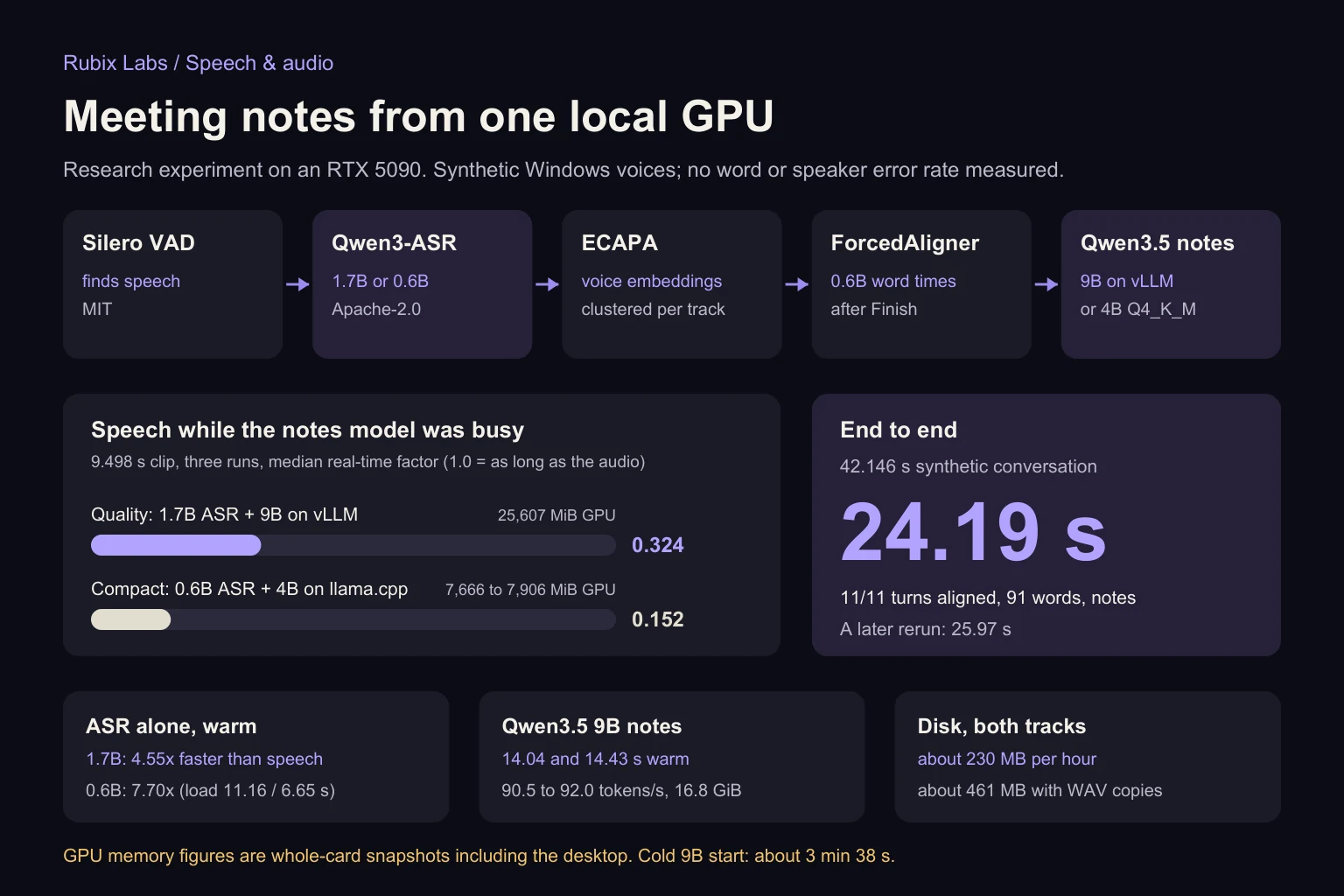
Five models, one machine
Silero VAD finds the stretches that contain speech. Qwen3-ASR turns them into text, with the 1.7B model on our quality setting and the 0.6B model on a compact one. Qwen's ASR doesn't say who spoke, so SpeechBrain's ECAPA model turns each stretch of speech into a voice embedding and we cluster those to label speakers. That's an experimental speaker pipeline we assembled, not a pretrained diarization system.
Microphone and system audio stay on separate tracks the whole way, and speakers are never merged across them. Labels are provisional while a meeting runs. After it ends, a final pass clusters each track across the whole recording, and Qwen3-ForcedAligner 0.6B predicts timings for every word so a click on a word plays it. Then Qwen3.5 writes the notes: the 9B model served by vLLM on the quality setting, or a 4-bit 4B model (Q4_K_M) on llama.cpp on the compact one.
Transcripts arrive in batches of about 12 seconds, stretching up to 24 seconds to find a pause, plus processing time. It isn't word-by-word streaming. Our write-up on Whisper chunking explains why we stopped cutting audio at fixed points.
| Job | Model | Licence on its card |
|---|---|---|
| Find speech | Silero VAD | MIT |
| Transcribe | Qwen3-ASR 1.7B or 0.6B | Apache-2.0 |
| Voice embeddings for speaker labels | SpeechBrain ECAPA | Apache-2.0 |
| Word timestamps | Qwen3-ForcedAligner 0.6B | Apache-2.0 |
| Notes | Qwen3.5 9B, or 4B at Q4_K_M | Apache-2.0 |
Why Qwen, and what we left out
Every model in the default path declares MIT or Apache-2.0 on its card, everything runs locally, and Qwen3-ASR came top of the English shortlist we drew up at the start. Its card lists 30 languages and 22 Chinese dialects, English among them. Whisper came up later, mostly for a second-language idea that we dropped before running any audio through it; faster-whisper was the runtime we'd have tried. We never ran Whisper in this experiment, so this isn't a Qwen against Whisper result.
One speaker-labelling model was a real contender and still stayed out. NVIDIA's streaming Sortformer does diarization directly, but its card limits it to four speakers and its weights come under the NVIDIA Open Model License Agreement, not MIT or Apache. We wanted a default with no licence exceptions, so we kept ECAPA embeddings and our own clustering. That's our reading of the cards as published on 24 November 2026, not legal advice.
How fast it ran on an RTX 5090
The machine had an RTX 5090 with 32 GB of VRAM, a Ryzen 9 9950X3D and about 190 GiB of RAM, running Windows. Speech ran on CUDA through Transformers, and the 9B notes model ran in vLLM under Docker.
Our controlled clip was four turns alternating between two Windows voices: 38.146 seconds of speech, 42.146 seconds with the gaps. Warm, the 1.7B model got through speech detection, transcription and voice embeddings 4.55 times faster than the speech lasted, after an 11.16-second model load. The 0.6B model ran 7.70 times faster after a 6.65-second load. The words matched the script when we read them, and that's as far as the accuracy check went.
We also timed a 9.498-second clip three times while the notes model was busy summarising. On the quality setting the median real-time factor was 0.324, so processing took about a third of the audio's length, with 25,607 MiB of GPU memory in use. The compact setting managed 0.152 at 7,666 to 7,906 MiB. Those memory figures are whole-card snapshots that include the desktop.
End to end, the 42.146-second conversation came back in 24.19 seconds with 11 of 11 turns aligned, 91 words, two speaker labels and one set of notes. A rerun after later changes took 25.97 seconds. Qwen3.5 9B on its own produced notes that passed our quote checks in 14.04 and 14.43 seconds across two warm requests, or 90.5 to 92.0 completion tokens per second of total request time, prompt processing included. Its text-only weights took about 16.8 GiB of GPU memory, and one cold restart took about 3 minutes 38 seconds, mostly spent loading weights from a Windows-mounted folder.
Dictation is the same speech path without speakers or notes. A warm 25.8-second capture, a Windows voice played into a real microphone, was transcribed 0.65 seconds after we pressed Stop.
| Measurement | Result | Conditions |
|---|---|---|
| Qwen3-ASR 1.7B, warm | 4.55x faster than the speech | 38.146 s of synthetic speech; 11.16 s load |
| Qwen3-ASR 0.6B, warm | 7.70x faster than the speech | Same clip; 6.65 s load |
| Quality setting under load | Real-time factor 0.324; 25,607 MiB | 1.7B ASR while 9B notes ran on vLLM |
| Compact setting under load | Real-time factor 0.152; 7,666 to 7,906 MiB | 0.6B ASR while 4B Q4_K_M notes ran on llama.cpp |
| Whole pipeline | 24.19 s (rerun 25.97 s) | 42.146 s synthetic conversation, 11 of 11 turns aligned |
| Qwen3.5 9B notes | 14.04 and 14.43 s | Two warm requests, 1,270 and 1,327 output tokens |
Disk space, and what the cloud would charge
Both tracks together take about 230 MB per recorded hour as two-second, 16 kHz mono chunks, or about 461 MB if you also keep the final WAV files. Nothing deletes old recordings automatically, so decide on disk space and a retention rule before the first long meeting.
The experiment also had an optional OpenAI path. Our planning estimate assumes one transcription pass per track plus 35,000 input and 6,000 output notes tokens per meeting hour. OpenAI's pricing page, checked on 24 November 2026, lists gpt-4o-mini-transcribe at an estimated $0.003 per audio minute and GPT-5.6 Luna at $0.20 per million input tokens and $1.20 per million output tokens. That puts a two-track hour at about $0.37, or about $0.73 with gpt-4o-transcribe-diarize at $0.006 a minute for its speaker labels.
We never made a live OpenAI call, so those are estimates from published rates, not invoices. Regenerated notes, questions, retries and how densely people talk all move the bill. Local mode has no API charge, but the GPU, the power and someone to look after it aren't free, and we didn't price those.
What this doesn't tell you
- Accuracy. Every timing comes from synthetic conversations voiced by Windows text-to-speech. We measured no word error rate and no diarization error rate, and clean synthetic voices flatter both transcription and speaker labels.
- Real meetings. Accents, cross-talk, overlapping speech and poor call audio weren't tested. Overlapping voices aren't separated, and a speaker change inside one turn gets flagged for review, not solved.
- Other hardware. Everything ran on one RTX 5090. The compact setting's measured memory makes a 12 to 16 GB card worth testing, but we haven't run it on one, or on a Mac.
- Long sessions in a real browser. Our hour-long and eight-hour checks were an API replay and an accelerated processor test; the Chrome capture write-up has the details.
Running it on your own hardware
If meeting audio has to stay on hardware you control, this stack is a sensible place to start. Fund the accuracy test first: a few hours of consented recordings from your own meetings, scored for word errors and speaker mistakes before anyone relies on the notes. Rubix can run that evaluation and set up the private model hosting around it; both are on our pricing page.