Speech & audio
Duplicate lines in your transcript? Speakerphone echo, and how we marked it
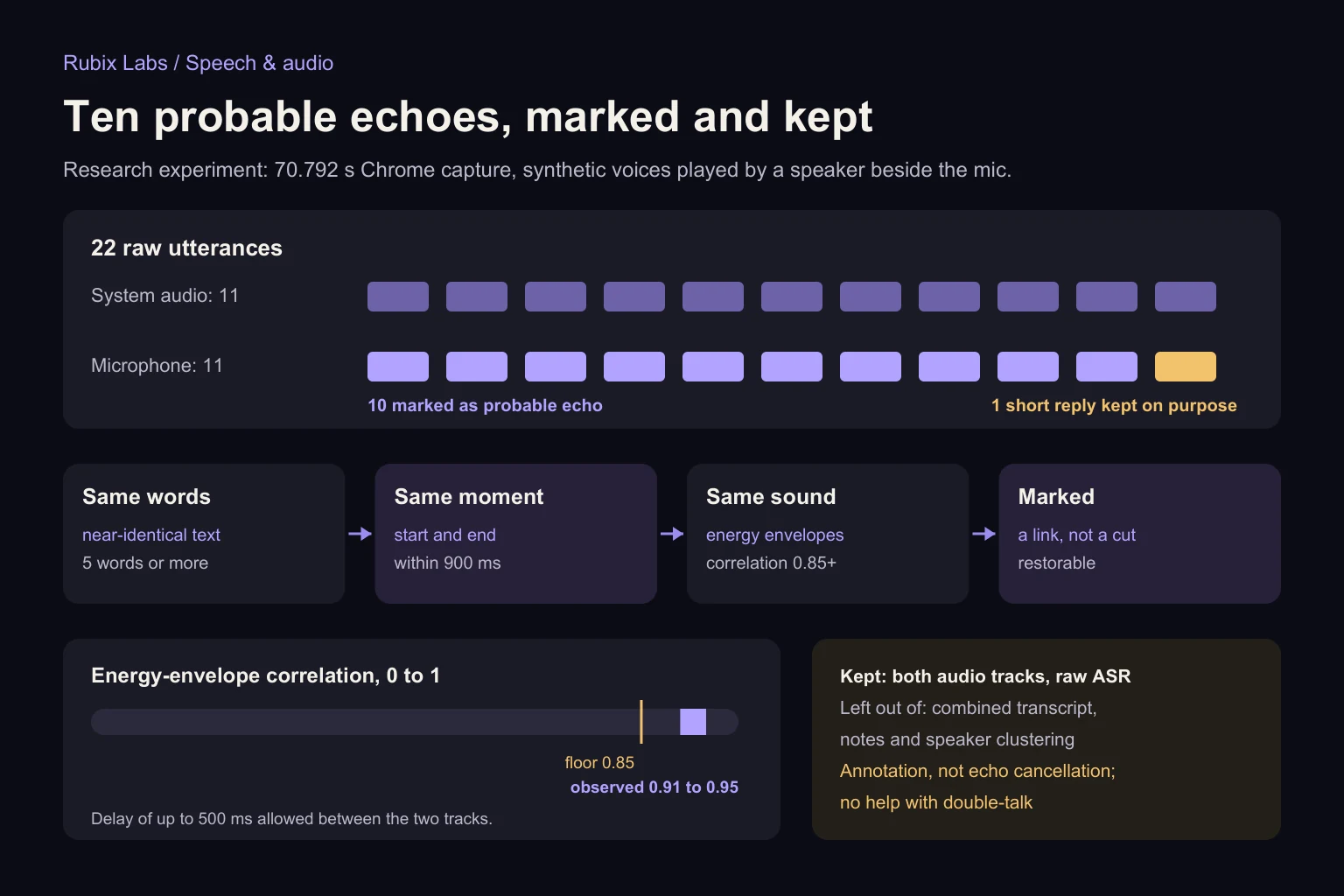
Record the microphone and the system audio while a call plays through speakers, and the transcript can say everything twice: once from the call and once from the microphone hearing the speaker. In a research experiment, 11 of 22 transcribed utterances were exactly that. We marked 10 of them as probable echoes, using three checks that all had to agree, kept the 11th on purpose and deleted nothing.
Where the second copy comes from
Our recorder keeps the microphone and system audio as separate tracks and transcribes both. For this test we played a short synthetic conversation, voiced by two Windows text-to-speech voices, through a desktop speaker with the microphone right beside it, and captured 70.792 seconds in Chrome. The transcript had 22 raw utterances: 11 from the system audio and 11 from the microphone, and every microphone utterance was the speaker playback.
Browser echo cancellation may not catch this. In the W3C Media Capture spec, a remote-only mode removes incoming WebRTC audio, an all mode tries to remove everything the system plays, and plain true leaves the choice to the browser. Our recorder asks for echo cancellation and requests the all mode only when the microphone reports supporting it. We didn't record which mode Chrome applied during this test, and the playback reached the transcript either way. The setting still matters: in a separate dictation test where we wanted the microphone to pick up a speaker on purpose, we switched echo cancellation and noise suppression off so they couldn't remove it.
Separate tracks are what make the problem fixable after the fact. With one mixed track, a duplicate is just a repeated sentence. With two, you can compare what the speaker played against what the microphone heard at the same moment.
Three checks that all have to agree
Matching text alone would be a poor test. Two people can read out the same line, and people repeat what the other side just said. So a microphone utterance is only marked as a probable echo of a system utterance when it passes all three checks in the table below.
The audio comparison only runs on pairs that already passed on words and timing. The ten matches correlated at about 0.91 to 0.95, comfortably above the 0.85 floor.
The eleventh microphone utterance was a two-word thank-you. It was speaker playback too, but it fell under the five-word minimum and stayed in the transcript. That's deliberate. A short 'thanks' or 'yes' from the room is often a real reply, and we'd rather show a duplicate than drop one.
| Check | Rule | What it rules out |
|---|---|---|
| Same words | Near-identical text after ignoring case and punctuation, at least five words | Short phrases that repeat naturally in conversation |
| Same moment | Start and end each within 900 ms of the system utterance | The same sentence said again later |
| Same sound | Energy envelopes correlate at 0.85 or more, allowing up to 500 ms of delay | Matching words that the microphone didn't hear from the speaker |
Mark the echo, keep the evidence
A probable echo is stored as a link between two utterances, on its own. The microphone audio and the raw transcription stay untouched. Linked lines are left out of the combined transcript, the notes and speaker clustering, and a review screen lists them so anyone can restore one; we tested that restore in the interface. Changing whether a line counts as an echo marks notes made from the old version as out of date. The raw transcript always keeps every line, so both copies are still there for anyone who wants them.
This is annotation, not echo cancellation. Nothing is subtracted from the waveform, and it does nothing for double-talk, where someone in the room speaks over the remote side. In that case both voices stay mixed in the microphone track.
What one test can't tell you
- It was one short session with synthetic voices and a speaker right beside the microphone. Real rooms, real voices and quieter playback will behave differently.
- No one spoke into the microphone independently during the test, so we don't know how often a genuine reply would be wrongly marked. We didn't measure false echo marks.
- Short duplicates stay by design, so some repeated lines will remain in the combined transcript.
- The speech figures behind it come from Windows text-to-speech, with no word error rate or speaker labelling error measured.
- Headphones are still the simplest fix: if the speaker never plays the call, the microphone never hears it.
If your transcripts repeat themselves
Check three things before writing any code: whether you're recording both tracks, whether people are on speakers, and which echo cancellation setting the browser reports for the microphone track. If duplicates remain, a reversible match on words, timing and audio is cheap to add, and it keeps the original evidence for anyone who disagrees with a mark.
We'd also show how many lines each recording hid as echoes, next to the way to review them. A high count suggests someone was on speakers, and it gives whoever checks the notes a reason to listen to the microphone track before trusting who said what.
Rubix builds transcript pipelines like this one. Our AI and agentic systems service and pricing page cover a first evaluation on your own recordings, and our Chrome capture write-up explains how the two tracks were recorded.