Submission intake
Reads the broker email and the ACORD 125, 127 and 129, flags contradictions and missing documents, and writes the underwriter brief and the reply.
A person keeps: Appetite, pricing and the quote.
AI agents for insurance
An AI agent for insurance reads what arrives (broker emails, ACORD forms, certificates, customer requests), checks it against your rules and systems, and prepares the next step for a person to approve. It doesn't quote, bind or confirm a change on its own. The two demos below run on real ACORD forms filled with fictional data.
Where agents help
Insurance work is full of reading, checking and chasing before anyone makes a decision. That preparation is where agents save time, as long as each one knows exactly where its job stops.
Reads the broker email and the ACORD 125, 127 and 129, flags contradictions and missing documents, and writes the underwriter brief and the reply.
A person keeps: Appetite, pricing and the quote.
Extracts limits, dates and the holder from ACORD 25 certificates, compares them with your written requirements and asks for corrections.
A person keeps: Exceptions, waivers and unclear fields.
Takes the request, collects what's missing and drafts the ACORD 175, then keeps the customer told exactly where it stands.
A person keeps: Signing, sending and accepting the carrier's result.
Classifies and extracts loss runs, driver licences, declarations pages and schedules, with a confidence floor on every field.
A person keeps: Anything below the floor, in a review queue.
Compares the expiring schedule with the new one, chases missing renewal information and prepares the remarketing packet.
A person keeps: Which markets to approach and what to recommend.
Captures the loss details (an ACORD 2 for auto), checks the basics against the policy and routes it to the right adjuster.
A person keeps: Coverage decisions and reserves.
Demo 1 · Submission intake
A broker sends a seven-truck fleet on ACORD 125, 127 and 129. Run the agent: it reads all three forms, checks them against the email and each other, then writes the brief and the reply. Click any finding to see it on the form.
Submissions inbox
From Dana Demo <submissions@example.com>
Received Mon 11/23/2026, 9:42 AM
Hi team,
Please quote the attached for Rubix Demo Freight LLC, a regional dry van carrier out of Sample City, WY. They run 6 power units and 7 drivers, all within 500 miles.
Their current carrier is non-renewing on 1/1, so timing matters. ACORD 125, 127 and 129 attached. An indication by Friday 11/27 would be great.
Thanks, Dana Demo Example Demo Agency (fictional)
Intake agent
The agent reads the email and all three ACORD forms, checks them against each other, and writes a brief for the underwriter plus a reply to the broker.
The form extraction is prepared in advance. The checks themselves run in your browser when you press run.
Demo 2 · Policy change
A customer asks to add a financed tractor. The agent collects what’s missing and drafts the ACORD 175, but it can’t change the policy. Ask “is it done yet?” at any point, then play the agency and the carrier.
Customer chat
Agency workspace · SR-1042
Reference SR-1042 recorded with the original message
Owner: Customer. Garaging ZIP and GVW not yet supplied.
ACORD 175 drafted, not signed or sent
ACORD 175 sent; no endorsement returned yet
Endorsement DEMO-END-0007 and revised ACORD 25
Demo 3 · Certificate compliance
Submit a certificate as a carrier, watch the rules evaluate the limits, dates and holder, then review the uncertain field and request a correction from the admin side.
Open the COI demo ↗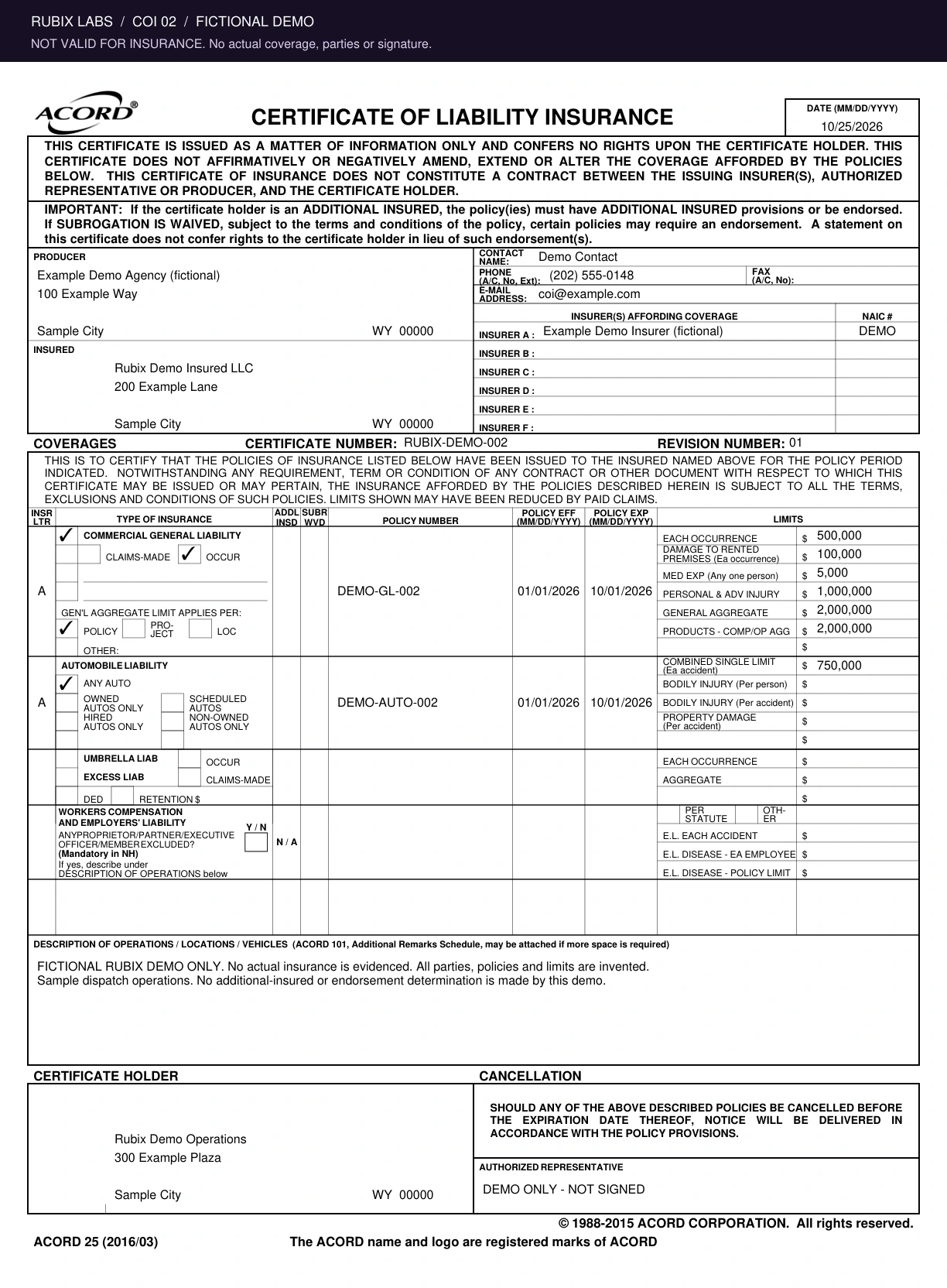
How we build them
The demos show the behaviour. These are the pieces that make it hold up with real documents, real carriers and a real compliance team.
Inputs, decision points and who approves what. We start with the workflow your team repeats most, not a general assistant.
Every field carries its source and a confidence. Below the floor it goes to a person; the agent never fills a gap with a guess.
VIN check digits, limits, dates, required documents and appetite rules run as tested code, so the same input always gives the same answer.
Read and draft by default. Anything that changes a record, sends to a carrier or commits to a customer needs an authorised person.
The agent can only report what a system has recorded, so a customer is never told a change is done before the carrier confirms it.
Redacted cases from your own book, scored before go-live, then logs and spot checks after. Prompt injection in documents is tested on purpose.
Rubix Labs' insurance work has connected Salesforce and Zoho quote workflows, CoverWhale and Progressive carrier integrations, GlobalSign document signing, FMCSA SAFER carrier data and Sensible document extraction to customer and operations software on AWS. It spans US trucking insurance (LuckyTruck), certificate-of-insurance compliance for a dispatch network (COI Compliance), a multi-line insurance marketplace in Pakistan (EasyInsurance) and driver-licence OCR (Document OCR).
For EU clients, the EU AI Act treats AI used for risk assessment and pricing in life and health insurance as high-risk. In the US, many states have adopted the NAIC model bulletin on insurers’ use of AI, which expects governance and documentation. Agents like these stay on the preparation side, and a person makes the decision. We agree data location, retention and access before any real document is used. This is how we build, not legal advice.
A first insurance agent is usually a fixed-price project around one workflow. If the workflow isn’t settled yet, the product and architecture sprint (US$7,500) produces the scope, an evaluation plan and an investment range. See the pricing page for our published starting prices.
02Common questions
Prepare work: read submissions and ACORD forms, find contradictions and missing documents, draft briefs, replies and change requests, check certificates against requirements, and keep customers updated on request status. People keep the decisions: appetite, pricing, binding, coverage and anything that changes a policy.
No. It leaves the premium blank until the carrier's quoting system returns one, and it drafts changes such as an ACORD 175 for an authorised person to sign and send. Its permissions are set in the software, not in a prompt.
The ones your team already uses, after we confirm access. Our published insurance work connected Salesforce and Zoho quote workflows, CoverWhale and Progressive carrier integrations, GlobalSign signing, FMCSA SAFER data and Sensible document extraction on AWS. Agency management systems and carrier portals are scoped per project.
We agree data location, retention and access before any real document is used, give the agent least-privilege access, keep an audit log of what it read and drafted, and test it against instructions hidden inside documents. Demos like the ones on this page use fictional data only.
A first workflow is usually a fixed-price project. Teams that haven't settled the workflow yet often start with the product and architecture sprint (US$7,500) to get the scope, evaluation plan and an investment range. Model and API usage is billed at cost, separately.