Speech & audio
Real-time Whisper transcription: the chunking mistakes in our prototype
In January 2025 we built a quick research prototype that transcribed Microsoft Teams calls live with Whisper. Reading its code again, we found three mistakes in how it fed audio to the model, and any one of them would spoil a live transcript. We never measured that prototype, so the first half of this article comes from reading code, not from test results. The second half covers what a later experiment changed, including the one chunking problem we did measure: fixed cuts that split words.
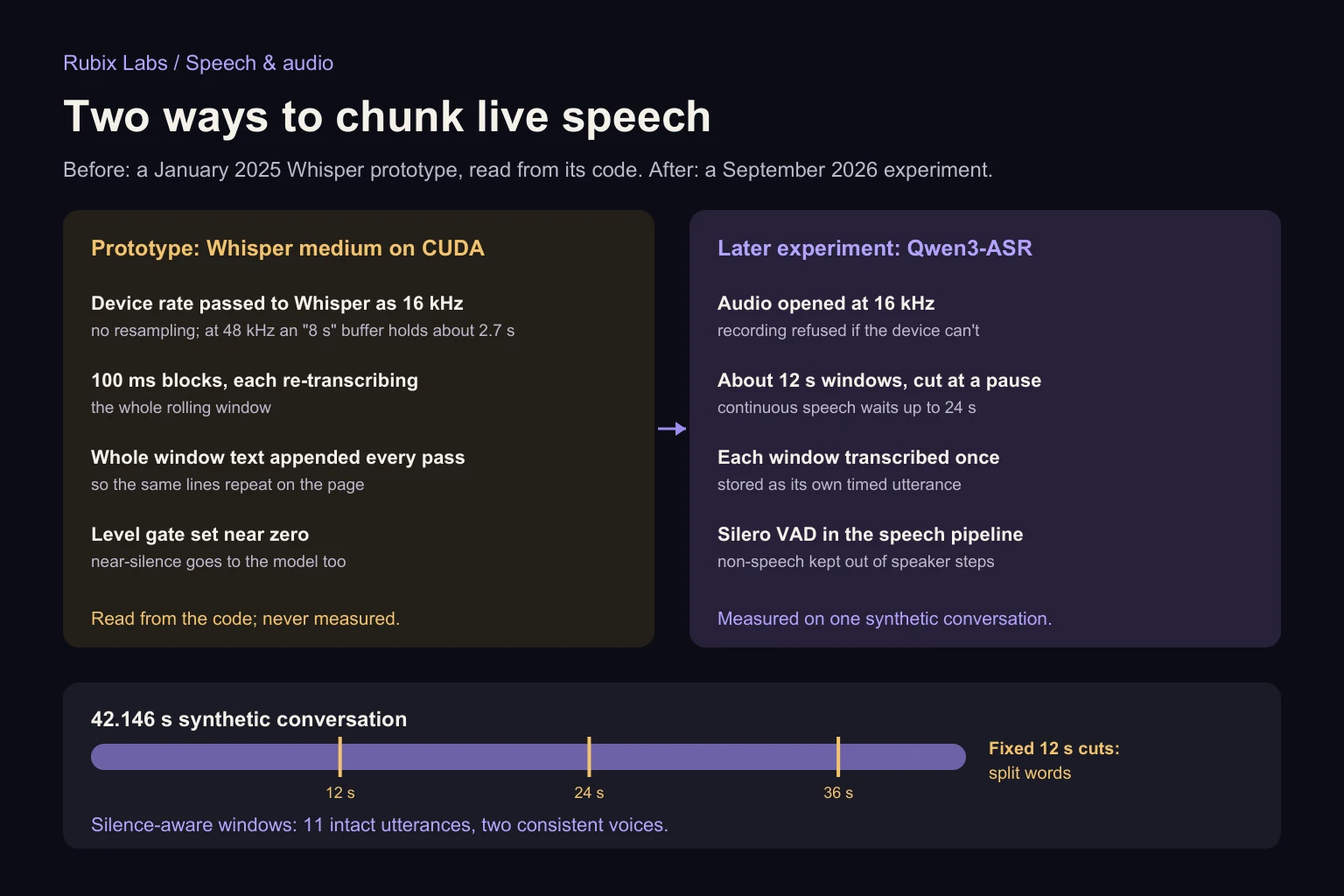
The January 2025 prototype
Teams played its audio into a virtual audio cable driver. A Python service read the cable's output as an input device, ran openai-whisper's medium model on CUDA and pushed each result over a WebSocket to a small React page. The README described 5-second chunks. The code did something else.
Mistake one: the wrong sample rate
The capture stream opened at the device's default sample rate, and a comment in the code points to a 48 kHz device. Those samples went straight to Whisper, which was told they were 16 kHz. Whisper's audio code fixes its sample rate at 16,000 Hz, and its spectrogram function expects an array that's already at 16 kHz. Only its file loader resamples, through ffmpeg.
At 48 kHz, Whisper would have heard every second of speech stretched over three seconds, with every frequency divided by three. The rolling buffer was sized in 16 kHz samples too, so its 8 seconds would have held about 2.7 seconds of real audio. The fix is to resample before the model, or to do what our later experiment does: open the audio at 16 kHz and refuse to record if the device can't.
Mistake two: transcribing the same audio again and again
Audio arrived in 100 ms blocks. Each block was added to the rolling window, and then the whole window went through Whisper again: one full transcription per block, or ten per second of audio if it kept up. Whisper's encoder expects 30-second input, and its own code pads shorter audio to that length. We never measured whether the prototype kept pace.
The text handling was worse. Each pass returned the transcript of the whole window, the server sent all of it, and the page appended it to what was already there. A sentence sitting in an 8-second window would be transcribed and appended on every block until it slid out, so the page would fill with repeated, slightly different copies of the same lines.
The fix is to treat each window as a timed utterance, transcribe it once and store it with its start and end. If you want faster partial results, replace the provisional text for that stretch of time instead of appending to it.
Mistake three: a silence gate that let everything through
Blocks were only queued if their peak level cleared a threshold, but the threshold sat so close to zero that almost any background noise passes it. The gate did nothing in practice, so near-silent audio went to Whisper like everything else.
That matters because Whisper's model card warns that its predictions may include text that was never spoken, and that it's prone to repeating itself. Feeding it silence gives both habits room to show. We kept no examples from this prototype, so we can't say how often it happened here. A voice activity detector in front of the model is a common fix; our later experiment runs Silero VAD to keep non-speech out of the speech steps.
What the later experiment changed
Our September 2026 meeting transcription experiment used Qwen3-ASR, not Whisper, but it ran into the same chunking question. It first cut audio at fixed 12-second marks, and those cuts split words. We switched to silence-aware windows: aim for about 12 seconds and cut at a short quiet stretch, and if someone keeps talking, wait up to 24 seconds for a pause before cutting anyway.
On a 42.146-second synthetic conversation voiced by two Windows text-to-speech voices, that produced 11 intact utterances and two consistent voices. Each window is transcribed once and stored as its own utterance with timestamps, so nothing gets appended twice, and the browser opens audio at 16 kHz or refuses to record. The cost is latency: text arrives in batches of roughly 12 to 24 seconds of audio plus processing time, not word by word. We scored no word error rate on this conversation.
| Problem | January 2025 prototype, read from code | Later experiment |
|---|---|---|
| Sample rate | Device rate passed to Whisper as 16 kHz, no resampling | Audio opened at 16 kHz; recording refused otherwise |
| Window | 8-second rolling window, re-transcribed every 100 ms block | About 12 s, extended up to 24 s to reach a pause |
| Text | Whole window appended on every pass | Each window stored once as a timed utterance |
| Silence | Level gate set near zero | Silero VAD in the speech pipeline |
| Evidence | None measured | 11 intact utterances on a 42.146 s synthetic conversation |
If you're building live Whisper transcription now
Resample to 16 kHz mono and check that you did. Decide what a window is, transcribe each one once and keep its timestamps. Cut at pauses, not on the clock, and put voice activity detection in front of the model. Then measure word error rate on recordings that sound like your users, because none of these checks says whether the words are right.
If you'd rather not own the windowing, OpenAI's pricing page, checked on 24 November 2026, lists live transcription models, gpt-live-transcribe and gpt-realtime-whisper, at an estimated $0.017 per minute. We haven't tested either. Rubix can compare a hosted live model with a self-hosted pipeline on your own audio; our pricing page covers AI automation and private model hosting.