Speech & audio
Semantic search for meeting transcripts: hybrid vs keyword in SQLite
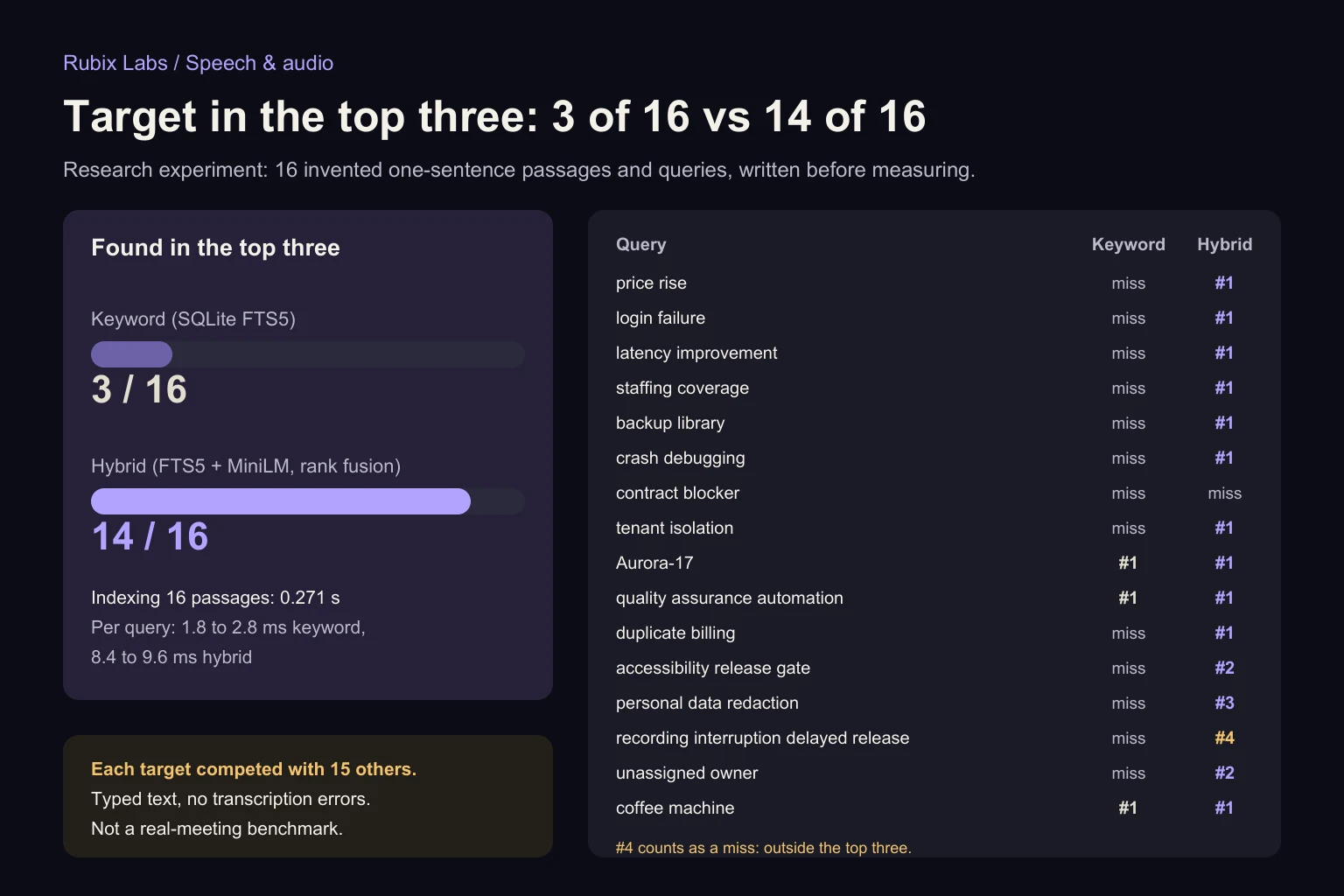
In a research experiment, we made meeting transcripts searchable with SQLite's built-in full-text search, then added a small embedding model that runs on the CPU and merged the two rankings. On 16 test queries we wrote ourselves, keyword search put the right passage in the top three 3 times. The hybrid found it 14 times. Sixteen sentences we wrote ourselves are enough to show how keyword search fails on paraphrase, and far too few to predict how either would do on your meetings.
Why keyword search misses meetings
People often remember a meeting in different words from the ones spoken. Someone remembers 'the price rise' when the transcript says 'The subscription charge is increasing next month.' SQLite's FTS5 matches tokens. Our setup added English stemming through its porter tokenizer, safe tokenized queries and a few small query expansions. Stemming helps with word forms such as 'automated' and 'automation', but a paraphrase that shares no tokens with the transcript can't match.
We'd seen that earlier with a probe built to expose it: 16 invented passages, six literal queries and six paraphrases. Keyword search found all six literal targets in the top five and none of the paraphrases. We picked those cases to show the gap, so the result proves the limit exists and says nothing about how often you'd hit it.
What we added
The embedding model is sentence-transformers' all-MiniLM-L6-v2: Apache 2.0, 384-dimensional vectors and about 91 MB. It runs locally on the CPU with two threads through ONNX Runtime, with no cloud embedding API and no vector database. Each transcript turn's vector sits in the same SQLite file with a hash of its corrected text and the model revision, and a query is compared with every stored vector in a plain exact scan. At 16 passages that's trivial. We haven't profiled a large library.
The two result lists are merged with reciprocal rank fusion, which adds up a score from each item's position in each list. We weight the keyword list slightly higher, so an exact name or ID still lands near the top. Project and archive filters apply to both lists before they're merged. If the embedding runtime is missing or fails, search falls back to keyword results.
Corrections matter for transcripts. A corrected passage is searchable by keyword at once, and its old vector is ignored until the index is rebuilt, so a semantic match can't come from words that were corrected away. One limit to plan for: the MiniLM card says input longer than 256 word pieces is truncated, so long turns need splitting at real tokenizer boundaries.
The test: 16 sentences we wrote ourselves
For the comparison we wrote 16 one-sentence passages, each with one short query, before taking any measurement. Most queries describe their passage in other words, such as 'login failure' for 'A customer could not sign in because the password expired.' A few keep an exact term: a made-up code name, 'Aurora-17', and 'coffee machine'. The passages went in as typed transcript turns, with no audio and no transcription errors, and each query was scored on whether its one target came back in the top three. Indexing all 16 took 0.271 seconds.
Hybrid search ranked 11 targets first, two second and one third. Its two misses are the useful part. 'contract blocker' returned nothing at all, so the passage about the legal team not approving a supplier agreement never appeared. 'recording interruption delayed release' put its target fourth, behind three other sentences, two of which mention a release or a recording. Keyword search found only three: the code name, the coffee machine and the test-automation sentence.
In this run a query took 1.8 to 2.8 ms with keyword search and 8.4 to 9.6 ms with hybrid. That tells you the embedding step is cheap at 16 passages, and nothing about a library of thousands of turns.
| Query | Target passage | Keyword rank | Hybrid rank |
|---|---|---|---|
| price rise | The subscription charge is increasing next month. | Not returned | 1 |
| duplicate billing | The customer requested a refund after being charged twice. | Not returned | 1 |
| coffee machine | The office coffee machine needs cleaning. | 1 | 1 |
| unassigned owner | Which engineer is responsible for the release? Nobody has volunteered yet. | Not returned | 2 |
| personal data redaction | The export should remove private phone numbers before the document is shared. | Not returned | 3 |
| contract blocker | The legal team has not approved the supplier agreement. | Not returned | Not returned |
What 14 of 16 does and doesn't show
- It's small. Each target competed with 15 other sentences. A real library holds thousands of turns, many about the same project, and near-duplicates would crowd the top three.
- We wrote both sides. The queries and passages came from the people who built the search, so they're cleaner than what someone half-remembers a week later.
- There were no speech errors. The passages were typed, so misheard words and names never got in the way, and no word error rate was measured anywhere in this experiment.
- Relevance isn't truth. A passage that matches a question about a decision may be the proposal that preceded it. Search finds candidates, and the quote checks in our meeting-notes write-up decide what was said.
What we'd test before switching models
MiniLM is an older, small baseline, chosen because it's tiny and Apache 2.0. The next candidate on our list is Qwen3-Embedding-0.6B, also Apache 2.0, with user-defined output sizes from 32 to 1,024 dimensions. It's larger, so it costs more memory and CPU time on every query.
Before promoting either, our plan calls for a separate held-out query set, scored on whether the target lands in the top ten: at least a 10-point gain on paraphrase queries, no loss on exact names and IDs, no results from archived or out-of-scope recordings, and acceptable latency on the smallest machine we'd support.
Rubix builds this kind of retrieval into knowledge assistants. Our pricing page lists a RAG knowledge assistant with permission-aware retrieval, cited answers and an evaluation set built from your own questions. If keyword search keeps missing what your team remembers, bring a few real queries and the passages they should find, and we'll test hybrid search on them before you commit.