LLMs & agents
AI meeting notes hallucination: the decision nobody made
In a research experiment, a local Qwen3.5 9B wrote notes from meeting transcripts and listed 'let us review feedback' as a decision. Nobody had decided anything. A prompt change and a wording check protected the decision list and missed the summary prose, so we changed what the model may produce: notes are now built only from exact quotes, and ordinary code checks each one against the transcript. A real long-input run also caught a token-counting bug on the way. The conversations were invented and voiced by Windows text-to-speech or typed, so this is a failure we found and contained, not an accuracy score.
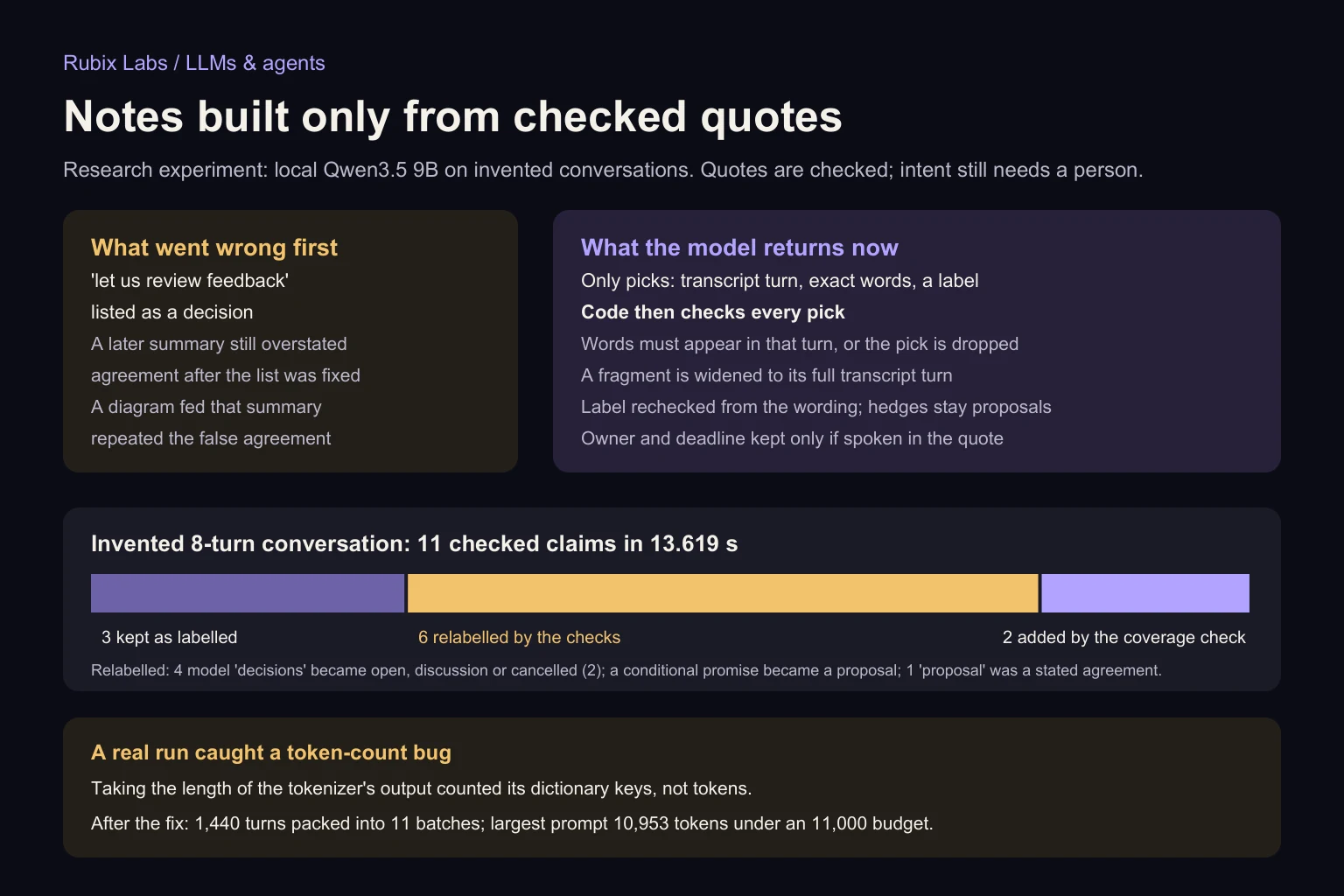
How a suggestion became a decision
The early notes looked useful. Two warm requests on our scripted test conversation returned structured notes with valid evidence links in 14.04 and 14.43 seconds, with 1,270 and 1,327 completion tokens. They caught the plan under discussion, the commitments, the open questions and the recommendations. They also put 'let us review feedback' under Decisions.
Our first fix was the usual one. The prompt spelled out the difference between a proposal and a decision, and a conservative check moved obvious proposal-only items out of Decisions and into suggestions. The decision list improved. A later run still overstated agreement in its summary and key points, because the check guarded the list and nothing guarded the prose.
Then the error travelled. When we generated a diagram from those notes using the summary prose, the diagram repeated the falsely agreed proposal and inferred a launch gate. Diagrams now receive only the cited transcript turns.
Notes made only of checked quotes
So the model stopped writing prose. It reads a batch of transcript turns and returns picks. Each pick names one turn, copies the exact words it relies on and labels them as a decision, commitment, proposal, open question, cancellation or plain discussion. It may suggest an owner and a deadline. There's no summary paragraph for it to write. Ordinary code then checks every pick before anything is saved.
- The quoted words must appear in that turn, allowing only for spacing, letter case and curly apostrophes. A pick that fails is dropped with a warning.
- A fragment that isn't a whole sentence is widened to the full turn, so a qualifier such as 'We have not agreed to that' can't be trimmed away.
- The label is recomputed from the wording, conservatively. Hedges and conditions such as 'let's', 'maybe' or 'if' make a proposal, a question or 'not agreed' makes an open question, and 'cancelled' or 'no longer' makes a cancellation. Only explicit words such as 'agreed', 'decided' or 'approved' make a decision.
- An owner survives only when the quote names the person committing, or a named speaker says 'I will'. A channel label such as 'Microphone' never becomes an owner. A deadline survives only when it's spoken in the quote, and 'Friday' stays 'Friday' instead of becoming a guessed date.
- A coverage pass looks for explicit statements the model skipped, such as a late question or a reversal, and adds them as quoted claims. It never adds prose.
What the checks changed on a test conversation
The notes show the result as chronological statement cards, each with its speaker and a timestamp that plays the moment. A later cancellation appears beside the plan it cancelled, and nothing silently decides that the latest statement wins. It reads less smoothly than a paraphrased summary, and we accepted that in exchange for every line pointing at its source.
To watch the checks work, we wrote eight short turns before measuring and gave them to the 9B model as transcript text. It took 13.619 seconds and returned 11 claims, every quote matching its source. The checks changed six of the model's labels and added two statements it had skipped.
The model called four statements decisions that weren't, two of them cancellations. We keep cancellations as their own label so a reversal stays visible next to what it reversed, and 'We decided to target Tuesday instead' stayed a decision beside the cancelled Friday release. The checks also corrected the other way once, promoting a statement that began 'We agreed' from the proposal the model had called it to a decision.
| Quoted statement | Model's label | After the checks |
|---|---|---|
| If the microphone tests pass, [name] will prepare a demo on Monday. | Commitment, with owner and day | Proposal; owner and day removed |
| We have not agreed to that. | Decision | Open question |
| We have not assigned an owner. | Decision | Discussion |
| We cancelled the Friday release. | Decision | Cancelled |
| The old plan was to buy a server, but that is no longer our plan. | Decision | Cancelled |
| Who will review the Mac results? | Not picked | Open question, added by coverage |
| Open question: should the follow-up email include an attachment? | Not picked | Open question, added by coverage |
The token-count bug a real run caught
Long meetings don't fit in one prompt, so turns are packed into batches under an input budget. The first version counted tokens by taking the length of what the tokenizer returned. In Hugging Face Transformers that's a BatchEncoding, which the documentation describes as derived from a Python dictionary holding the model inputs, such as input IDs and an attention mask. Its length is the number of keys in that dictionary, so every passage counted as a handful of tokens whatever its size.
Real execution caught it. We expanded the test conversation to 1,440 turns and packed it with the real tokenizer. The fix asks for the token IDs explicitly and counts those. After it, the 1,440 turns packed into 11 batches and the largest actual chat prompt was 10,953 tokens, under an 11,000-token budget. That check ran the tokenizer, not 11 long generations, and a regression test now covers the mistake.
The budget is tighter today: at most ten passages and 3,800 input tokens per batch, counted with the real tokenizer and the full chat template. If your batching code has only ever met short inputs, give it one very long real one.
What an exact quote doesn't prove
A checked quote proves the words are in the transcript. It can't show that speech recognition heard them correctly, that the speaker meant a commitment, or that every important statement was picked. In a separate 49-second microphone test, the notes kept literal quotes and still skipped one unassigned sentence about who would review some results. We measured no word error rate in any of this.
Wording rules are blunt, so intent still needs a person. The review step lets someone mark a claim as checked, and any correction to the transcript, a speaker or an echo decision marks older notes stale until they're regenerated. The notes prompt also treats transcript text as data and never as instructions, the same boundary our document AI prompt-injection write-up describes.
Rubix builds AI workflows where each claim points back to its source, with human review where a wrong answer would cost something. Our pricing page lists a RAG knowledge assistant with cited answers and an evaluation set. If your meeting summaries are inventing agreements, we can trace each claim back to the transcript with you and show which ones hold up.