Computer vision
RF-DETR vs YOLO26: accuracy, edge speed and licences
In a research experiment, we needed a vision model that could find a cat or dog in a photo and then name one of 353 breeds. We tried RF-DETR and YOLO26 in several roles. RF-DETR Nano ended up finding the animal and a YOLO26 classifier naming it; trained as breed models themselves, both detector architectures fell well short of that classifier. Rubix now starts fine-grained vision work from that split, and the licence terms shaped the choice nearly as much as the benchmarks did.
What each publisher reports
Roboflow's RF-DETR README lists RF-DETR Nano at 48.4 COCO AP50:95, 2.3 ms and 30.5M parameters, and Small at 53.0 AP, 3.5 ms and 32.1M. The same table puts YOLO26 Nano at 40.3 AP and 1.7 ms, and YOLO26 Small at 47.7 AP and 2.6 ms. All of those latencies were measured on an NVIDIA T4 with TensorRT, FP16 and batch size 1.
Ultralytics' own YOLO26 page gives slightly different figures: 40.9 mAP for YOLO26n and 48.6 for YOLO26s at 640 pixels, with T4 TensorRT10 times of 1.7 and 2.5 ms. It also lists CPU ONNX times of 38.9 ms for the nano model and 87.2 ms for small. If your edge device has no GPU, that's the column to read; the RF-DETR table has no CPU figure.
At Nano and Small sizes, then, RF-DETR reports more accuracy and YOLO26 reports lower latency with far fewer parameters: 30.5M for RF-DETR Nano against 2.4M for YOLO26n by Ultralytics' count. We haven't rerun either benchmark. These are each publisher's numbers, measured their way.
| Model | COCO AP50:95 | T4 latency | Parameters | Source |
|---|---|---|---|---|
| RF-DETR Nano | 48.4 | 2.3 ms | 30.5M | RF-DETR README |
| RF-DETR Small | 53.0 | 3.5 ms | 32.1M | RF-DETR README |
| YOLO26n | 40.9 (40.1 end-to-end) | 1.7 ms | 2.4M | Ultralytics docs |
| YOLO26s | 48.6 (47.8 end-to-end) | 2.5 ms | 9.5M | Ultralytics docs |
Read the licence before the leaderboard
RF-DETR Nano, Small, Medium and Large detection models are Apache 2.0, and so is the rfdetr package. The XL and 2XL detectors, along with the Atto, Femto and Pico sizes in the plus package, use Roboflow's Platform Model License (PML 1.0). The README says use on Roboflow is included, while self-hosted commercial use needs Roboflow's Enterprise add-on.
Ultralytics releases YOLO26 code, models and documentation under AGPL-3.0 and an Enterprise licence. Roboflow's YOLO26 licensing page says every Roboflow plan includes a commercial licence for YOLO26 models trained or deployed on its cloud, for as long as you keep the plan. Running them on your own hardware through Roboflow Inference needs an Enterprise add-on, and running them outside Roboflow is an Enterprise conversation.
For a closed commercial system you plan to self-host, RF-DETR N to L is the easy licence on paper. We hosted both of our models on Roboflow, which is why a YOLO26 classifier was workable for this experiment. That's our reading of the published terms, not legal advice, and terms change; have counsel read the versions that apply when you sign.
Our experiment: one model finds, another names
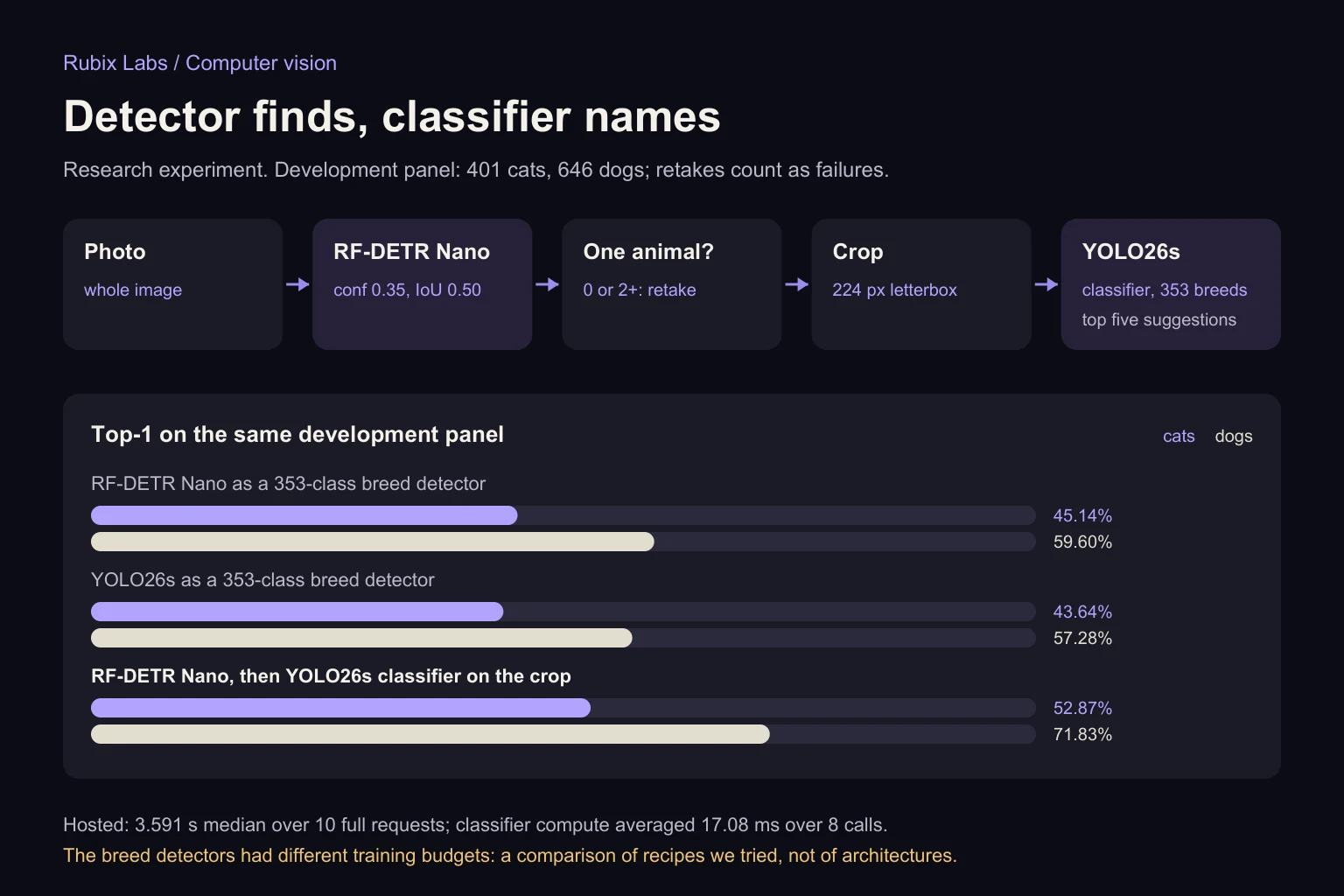
Our pipeline ran RF-DETR Nano on the whole photo at confidence 0.35 and IoU 0.50. Zero animals, or more than one, ended the run with a request for a retake; we never guessed which animal someone meant. With exactly one, we cropped the box with a small margin, letterboxed it to 224 pixels and passed it to a YOLO26 small classifier with 353 breed classes.
On its 1,392-scene development evaluation at those thresholds, the detector correctly found and labelled 594 of 609 cats (97.54%) and 680 of 680 dogs. It accepted 16 of 146 scenes with no animal in them and missed the retake on 4 of 52 scenes with several. On 6,305 held-out test photos it never saw in training, each with one animal, it found exactly one in 6,182 (98.05%).
The classifier then got 52.87% of cats and 71.83% of dogs right first time on our development panel of 401 cats and 646 dogs, with retakes counted as failures. We've reused that panel across many rounds and it's deliberately hard, so treat it as a comparison tool. The held-out photos scored much higher, for reasons our distillation write-up explains.
Detector architectures as breed models
We also trained each family's detector architecture as a 353-class breed model and scored it on the same crops. RF-DETR Nano, with 31,413,572 parameters, reached 45.14% of cats and 59.60% of dogs after a 30-epoch fit and a 30-epoch refinement. YOLO26s as a detector, with 10,221,086 parameters, reached 43.64% and 57.28% after 30 epochs. Both trail the YOLO26 classifier by a wide margin.
The training budgets weren't matched and we ran one seed of each, so this doesn't show that one architecture beats the other at breeds. It did settle our design. In the recipes we tried, a classification head on a clean crop named breeds better than either detection head, which left the detector free to stick to finding the animal.
| Setup, same 401 cats and 646 dogs | Cat top-1 | Dog top-1 |
|---|---|---|
| RF-DETR Nano trained as a 353-class breed detector | 45.14% | 59.60% |
| YOLO26s trained as a 353-class breed detector | 43.64% | 57.28% |
| RF-DETR Nano detector, then YOLO26s classifier on the crop | 52.87% | 71.83% |
Speed and cost once it was hosted
Both models ran on Roboflow's serverless workflow API. Across eight hosted classifier calls, reported model compute ranged from 6.98 to 54.49 ms, with a mean of 17.08 ms. Ten authenticated requests through the whole pipeline took a median of 3.591 seconds, from 1.675 to 4.218. Most of that time sits outside the classifier's compute, so a 2 ms benchmark says little about how long a hosted request takes.
At Roboflow's published standard rates, RF-DETR Nano costs 0.125 credits per 1,000 images and a YOLO26 small detection model 0.1875, with custom code billed by execution time. Our estimate came to 0.00043607 credits per full scan. Ten requests is a small sample, and we didn't load-test it.
How we'd choose for a commercial model
If you'll self-host on a GPU and keep the software closed, start with RF-DETR N to L and check whether the extra accuracy is worth the parameter count on your hardware. If you need a tiny model on a CPU, YOLO26's published CPU times are hard to ignore; price the Enterprise licence or the hosting terms early, before a working demo makes the decision for you.
For anything fine-grained, try a detector plus a separate classifier before training one detector for every class. Then measure on your own photos. Rubix's pricing page lists computer vision and custom vision models under custom models, and our Shazam for Food case study shows photo recognition carried through to calorie estimates. Send us a sample of the images you need to read and we'll help run this comparison before you commit to a licence.