Computer vision
Vision LLM vs custom model: LLaVA 34B against a 5.9M classifier
In a research experiment, we gave the same 300 held-out cat and dog photos to two very different models: the 5.9M-parameter breed classifier we'd trained and distilled, and LLaVA 1.6 34B, an early-2024 open vision LLM running locally at 4-bit. The classifier named 78.0% of cats and 74.7% of dogs correctly first time. LLaVA managed 16.7% to 28.7%, depending on how we asked. The gap is large, and the test is narrow: one older open model, on photos that suit the classifier.
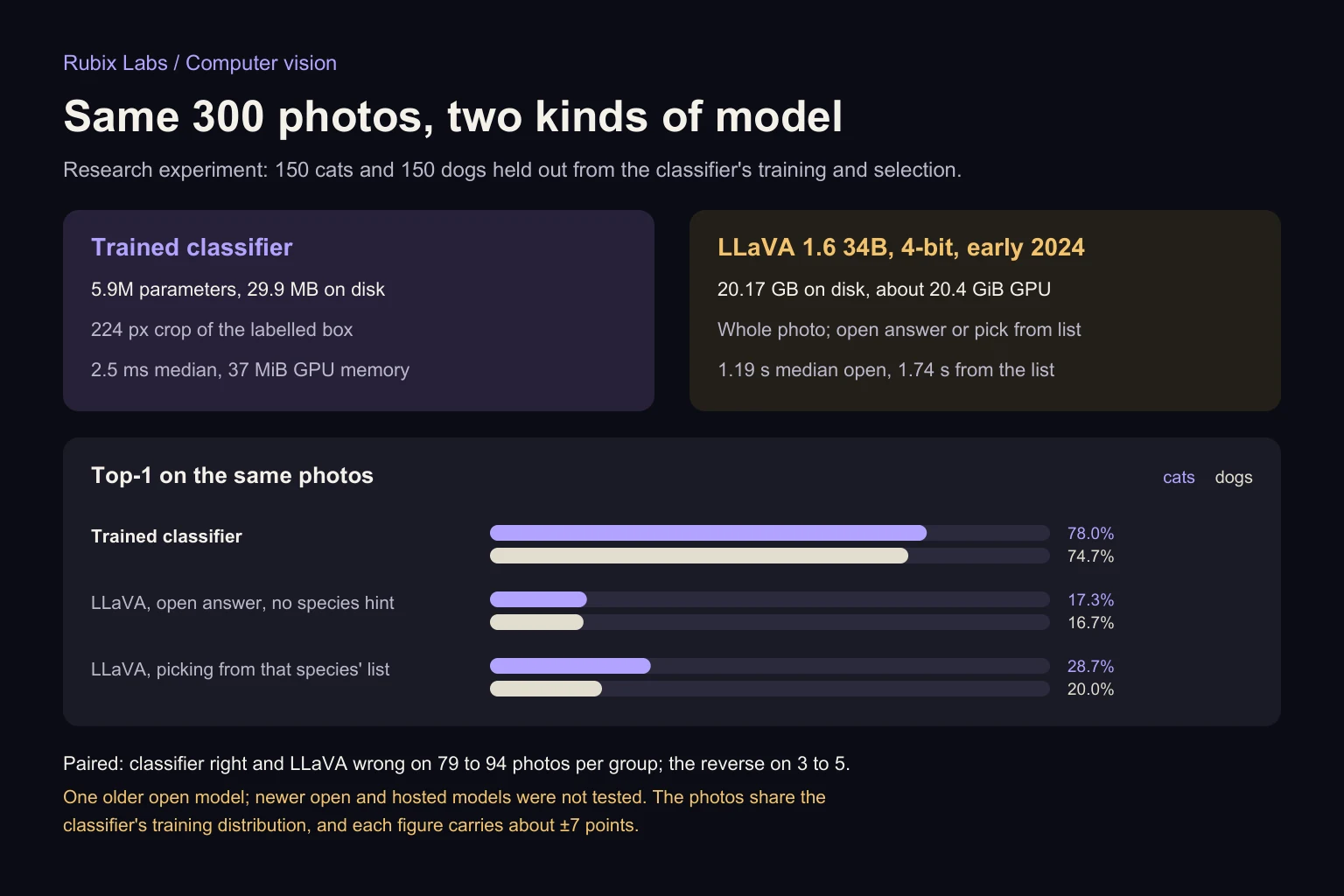
Same photos, two kinds of model
We drew 300 photos, 150 cats and 150 dogs, at random with a fixed seed from held-out test photos the classifier never trained on and that weren't used to choose it. They cover 25 cat breeds and 91 dog breeds out of the 353 the classifier knows, and every model saw the identical set.
The classifier got its usual input: a crop around the labelled box with a 15% margin, letterboxed to 224 pixels and ranked within the true species. LLaVA saw the whole photo, with the long side capped at 1,024 pixels, and we asked it two ways. In open mode it named the breed with no species hint, plus up to four alternatives. In list mode we told it the species and gave it that species' full list of 99 cat or 254 dog names to choose from, which matches how the classifier is scored.
Both LLaVA modes ran at temperature 0 with JSON output, and we mapped its answers to labels by exact name, a short table of naming variants, unique prefixes and a strict fuzzy match. Scoring was strict, so 'Poodle' for a Toy Poodle counts as a miss. LLaVA was the only vision LLM we could run locally for this test, and we didn't download anything new for it.
What each model got right
Matched photo by photo, the classifier was right where LLaVA was wrong on 79 to 94 photos in each of the four species-and-mode comparisons. LLaVA was right where the classifier was wrong on only 3 to 5. An exact McNemar test puts every one of those comparisons below p = 10⁻¹⁷.
With 150 photos per species, each percentage carries roughly ±7 points. That's small next to a gap of about 50 points, and large enough that the differences between LLaVA's two modes, or between cats and dogs, are much less certain. The classifier's figures on this draw sit within sampling error of its earlier measurement on all such held-out photos, 75.5% of cats and 78.5% of dogs, so the sample wasn't unusually kind to it.
| Model and mode | Cats top-1 | Cats top-5 | Dogs top-1 | Dogs top-5 | Median / p90 per image |
|---|---|---|---|---|---|
| Trained classifier, 5.9M parameters | 78.0% | 97.3% | 74.7% | 98.0% | 2.5 / 3.1 ms |
| LLaVA 1.6 34B, open answer | 17.3% | 35.3% | 16.7% | 24.7% | 1.19 / 2.44 s |
| LLaVA 1.6 34B, pick from the species list | 28.7% | 58.7% | 20.0% | 26.7% | 1.74 / 1.99 s |
Size, speed and memory
The classifier's weights file is 29.9 MB. Its forward pass took a median of 2.5 ms on the GPU (3.1 ms at p90) with 37 MiB of peak allocated memory, and 7.7 ms on the CPU. LLaVA 34B is 20.17 GB on disk, took about 20.4 GiB of GPU memory once loaded, and needed a median of 1.19 seconds per photo in open mode and 1.74 seconds from the list. That's about 675 times larger on disk and about 500 to 700 times slower per image on the same GPU.
Treat the timings as indicative. The GPU was shared with ordinary desktop programs, and the two numbers aren't measured the same way: LLaVA's is wall time for a local HTTP call, and the classifier's is the forward pass alone, without decoding or cropping.
How LLaVA got it wrong
It fell back on famous breeds. In open mode it answered 'Siamese' first for 63 of the 150 cats, and only 6 were Siamese; 'American Shorthair' came first 21 times, and none were. Its cat answers used 17 distinct first answers for 25 true breeds. Dogs got 'Labrador Retriever' 16 times, when 3 were, and 'Shih Tzu' 15 times, when none were.
Given the 254-name dog list, it leaned on the top of it: 72 of its 150 answers came from the first 10 names, where only 19 of the true breeds sat. In open mode it often named a type or a coat instead of a breed, such as 'Terrier' nine times, or 'Tabby' and 'Calico' for cats. It called 3 cats by dog breeds and no dogs by cat breeds.
In other ways it behaved well. All 600 replies were valid JSON with at least one breed, it never refused, and in open mode it invented a breed name only once. In list mode, 1,503 of the 1,507 names it returned were copied exactly or differed only in case. Being generous wouldn't rescue it either: counting type names such as 'Terrier' as correct when they fit lifts open-mode dog top-1 from 16.7% to 26.0%.
The classifier's misses were look-alike pairs, such as calling a British Shorthair a European Shorthair or a Beagle an English Foxhound. The true breed was in its top five for 293 of the 300 photos.
What this test doesn't show
- One older open model. LLaVA 1.6 is from early 2024 and ran at 4-bit. We didn't test newer open models or hosted ones such as Claude, GPT or Gemini, so this isn't evidence that vision LLMs score 20%. It shows that a general model of this class, run locally, sat far behind a small specialist.
- A home advantage. The held-out photos come from the same distribution as the classifier's training photos, which suits it far better than a stranger's phone photo would. The label conventions favour it too: coat-length variants are separate labels, and 'collie' means the rough collie.
- Different inputs. The classifier saw a crop of the labelled box, and LLaVA saw the whole photo. In a full pipeline a detector supplies the box, and our earlier whole-pipeline figures were within a point or two of the box-based ones.
- Small samples and one prompt each. Each figure carries about ±7 points at 150 photos per species, and each mode used one prompt wording with greedy decoding. Other wordings could move LLaVA's numbers by a few points.
- A shared GPU, so the latency figures are indicative.
When each one is the right call
A small trained model is the better bet when the label set is fixed and fine-grained, you have labelled examples, and the job runs often enough that milliseconds and megabytes matter. In this test a different prompt might move LLaVA a few points, and the gap was about 50.
A vision LLM is still a sensible first prototype when you don't have labelled data yet, when the categories are coarse or still changing, or when you want a description instead of a label from a fixed list. It needs a prompt rather than a training run, and it shows quickly whether the task can be done from the image at all. Test a current model before you decide; this experiment says nothing about one.
A path we'd often suggest is to prototype with a vision LLM, collect the cases people correct, and train a small model once you have labels and a settled taxonomy. Check those harvested labels, though. Ours defaulted to famous breeds and copied names from the top of a long list, and labels taken from it unchecked would carry both habits.
Rubix can run this comparison on your images: a current vision LLM against a small trained model, scored the same strict way, with size and latency measured. Our pricing page lists computer vision and custom vision models under custom models.