Computer vision
Best image classification model 2026: DINOv3, SigLIP 2, ConvNeXt
In a research experiment, we trained image classifiers to name 353 cat and dog breeds and tried most of the backbones people ask about: DINOv3, SigLIP 2, DINOv2, a DINOv3-distilled ConvNeXt and two older CNNs. DINOv3 came out on top, though the early frozen-feature results were closer than we expected. The gap opened when we trained it further on our own data. The licences pull in a different direction, so this is the whole picture as Rubix saw it.
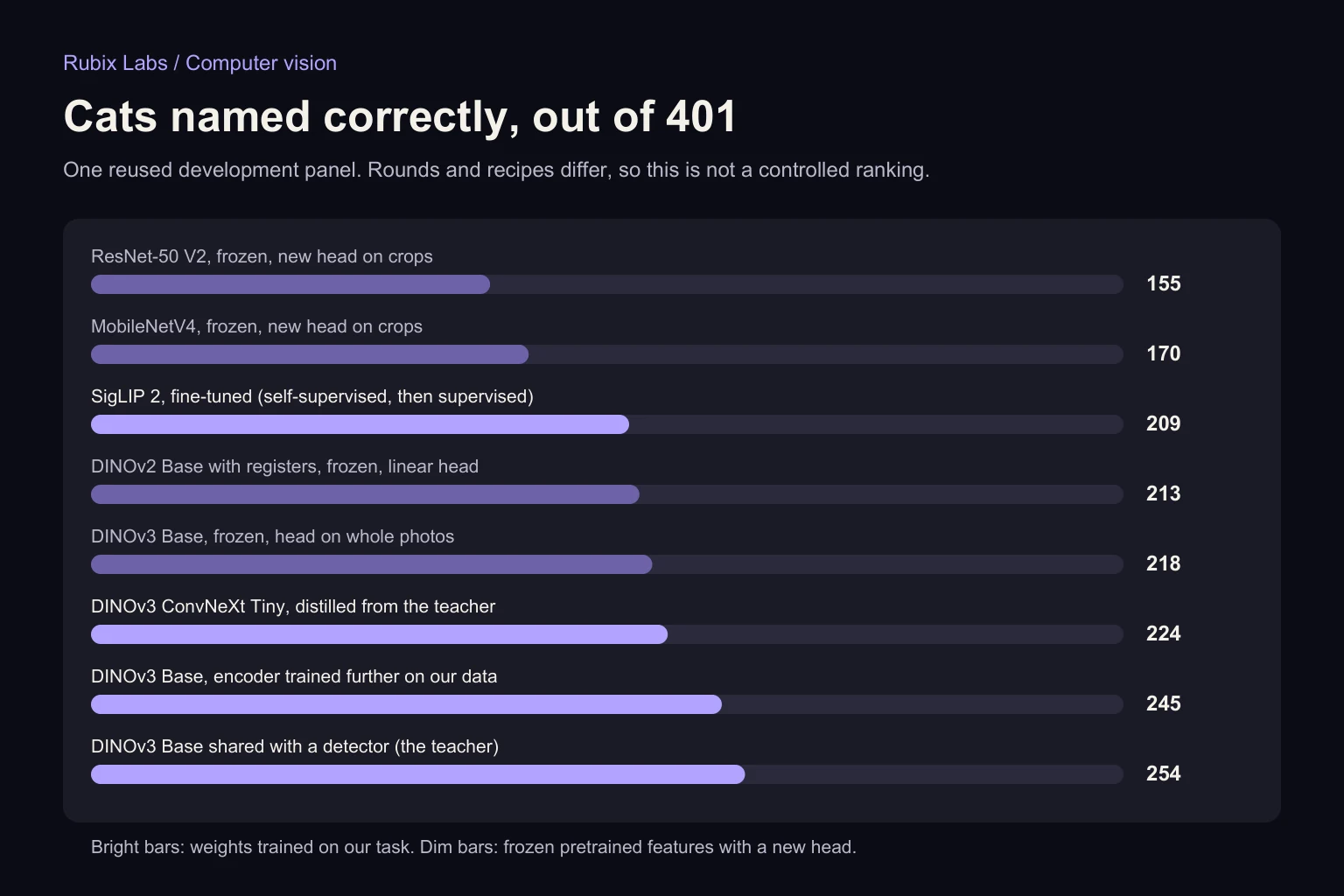
Frozen features were closer than we expected
We started cheaply: freeze a pretrained backbone, fit a new breed head and score it on the same development panel of 401 cats. That panel covers 55 of the 99 cat breeds the model knows, and we've reused it many times, so it's a comparison tool, not a measure of real-world accuracy.
Frozen DINOv3 Base, with a head trained on whole photos, named 218 cats correctly. DINOv2 Base with registers got 213 with a linear head. SigLIP 2 had a head start, because we'd already fine-tuned it on the task with a self-supervised step followed by a supervised one, and it got 209; fresh heads on its frozen fine-tuned features gave 203 to 211. The older backbones fell well behind, with MobileNetV4 at 170 cats from crops and ResNet-50 V2 at 155.
Nine cats separate SigLIP 2 and frozen DINOv3 there, on one seed, with recipes that weren't identical. In a separate paired check, SigLIP 2's self-supervised step rescued nine cats and lost five against plain supervised training, an exploratory p of 0.424. We wouldn't choose a backbone on differences that small.
| Backbone and how we used it | Cats correct of 401 | Dogs correct of 646 |
|---|---|---|
| ResNet-50 V2, frozen, new head on crops | 155 | Not compared |
| MobileNetV4, frozen, new head on crops | 170 | Not compared |
| SigLIP 2, fine-tuned, self-supervised then supervised | 209 | 509 |
| DINOv2 Base with registers, frozen, linear head | 213 | Not compared |
| DINOv3 Base, frozen, head on whole photos | 218 | Not compared |
Training DINOv3 on the task is where it pulled away
Once DINOv3 Base learned from our data, with the full training set and supervised-contrastive features, the crop pipeline reached 61.10% of cats and 80.65% of dogs.
Our best model shared that DINOv3 Base encoder between a Faster R-CNN detector and the breed heads: 254 of 401 cats (63.34%) and 520 of 646 dogs (80.50%). It has 95.11M parameters, its full native CPU pipeline peaked at about 4.5 GiB of process memory, and its warm median was 1.023 seconds per photo on our workstation. That's fine on a GPU server and awkward on a small CPU host.
So we distilled it. A DINOv3 ConvNeXt Tiny student kept 224 cats and 486 dogs with 28.09M parameters and a 112.49 MB ONNX classifier. The YOLO26 small classifier we eventually hosted kept 212 cats and 464 dogs with 5,895,201 parameters in 23.58 MB.
A note on ConvNeXt
Most people searching this question mean ConvNeXt V2. We didn't train ConvNeXt V2. The ConvNeXt in our results is Meta's DINOv3 ConvNeXt Tiny, fine-tuned as a student of our DINOv3 teacher, so it falls under the DINOv3 licence. Among our compact students it had the best dog top-1, while a DINOv3 ViT Small+ student had the best cat top-1 at 235 of 401.
ConvNeXt V2 has a licence detail worth knowing. Meta's repository releases the code under MIT and the ImageNet pre-trained and fine-tuned weights under CC-BY-NC. Non-commercial weights are a poor starting point for a commercial model, however good the architecture is.
The licences side by side
Google's SigLIP 2 model card on Hugging Face lists Apache 2.0, and DINOv2's code and weights are Apache 2.0 too. Those are the simple cases.
DINOv3 uses its own DINOv3 License. It grants a royalty-free licence to use, reproduce, distribute and modify the materials, but redistribution has to carry the same agreement, and it rules out uses including trade-control-restricted and military ones. The weights sit behind a request form. It isn't Apache, so have counsel read it before you ship weights built on it.
| Backbone | Licence | What we'd check |
|---|---|---|
| DINOv3, ViT and ConvNeXt | DINOv3 License | Same-agreement redistribution, use restrictions, gated download |
| SigLIP 2 | Apache 2.0 | Standard notices |
| DINOv2 | Apache 2.0 | Standard notices |
| ConvNeXt V2 | MIT code; CC-BY-NC ImageNet weights | Weights are non-commercial |
What we'd pick in 2026
For accuracy on a fine-grained task, start with DINOv3 and plan to train it on your own data, because frozen probes undersell it. If its licence is a blocker, SigLIP 2 and DINOv2 are reasonable Apache options; on our panel they started within a handful of cats of frozen DINOv3. Either way, budget for distillation if you need to serve on a CPU.
Held-out test photos the model never saw in training looked friendlier than our development panel, and our own phone photos looked worse than both. We wrote that part up separately. At Rubix, we'd run this comparison on your images and your licence constraints before recommending a backbone; the custom vision model line on our pricing page covers that kind of evaluation.