LLMs & agents
CrewAI vs LangGraph: four news pipelines, and why fewer agents won
In a research experiment that ran on and off from January 2025 to April 2026, we tried four times to build the same thing: a pipeline that reads tech-news RSS feeds and rewrites each article as a short summary in its own words, with the model running locally through Ollama. The first try was a CrewAI crew and the last was a LangGraph graph with 16 nodes per article. The version that held up gave the model the smallest job. Ordinary code fetched, extracted and checked each article, and the model planned and wrote the rewrite, plus the odd extraction the code couldn't manage.
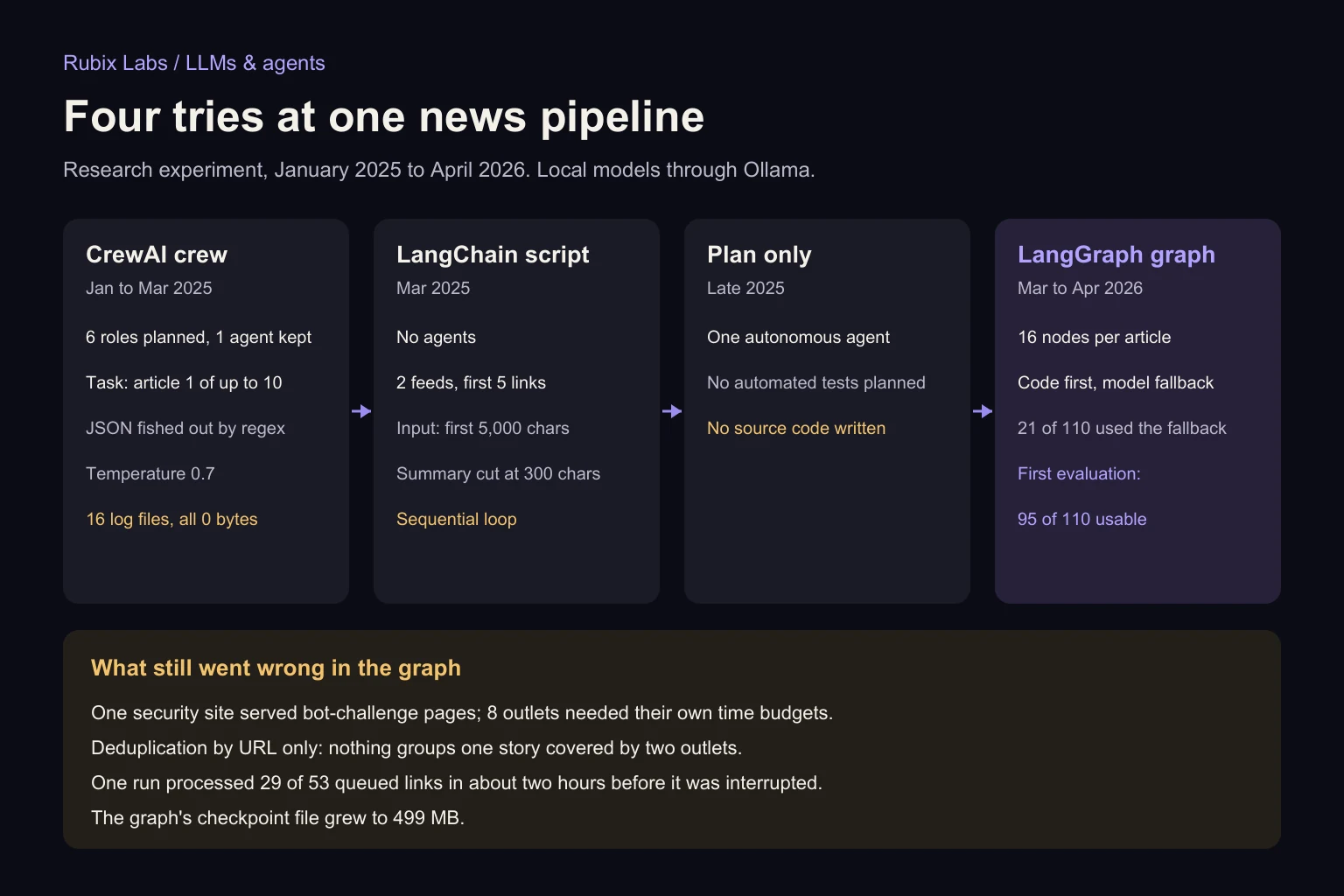
Try one: a CrewAI crew, January to March 2025
The crew started on Mistral NeMo 12B and later moved to qwen2.5:32b. Its memory store was still named after an earlier six-role design: a web scraper, a content extractor, a title specialist, a body content specialist, a date extraction specialist and a content formatter. By the last commit that had shrunk to one agent, a content fetcher with a scraping tool, and one task.
The task was the bigger problem. The code pulled up to ten recent items from 13 default sources, then wrote the task description from the first article alone, so a run processed one URL. The agent was told to return that article's complete text as JSON without summarising it, which turned the language model into a slow copy step. Tasks for analysis and summaries sat in files that nothing imported.
The answer came back as free text. The code hunted through it for JSON with a regular expression, handled three different answer shapes and sorted the results so the one with the longest content came first. CrewAI tasks can declare a JSON or Pydantic output schema, and we didn't use one. The model also ran at temperature 0.7, which is a lot of freedom for a job that's meant to copy text.
The README listed a processing time of about four to five seconds. Nothing backs that up: the crew wrote 16 daily log files between January and March 2025, and every one of them is empty.
Try two: a LangChain script with hard caps, March 2025
The second version dropped agents. It was one FastAPI file that read two RSS feeds, kept the first five links, scraped each page and asked Mistral NeMo 12B for a short summary. LangChain handled the Ollama connection and little else; a tool class was imported and never used.
The limits were written into the code. The model saw the first 5,000 characters of each article, the summary was cut at 300 characters with an ellipsis, and when the model was unavailable the script used the article's first three sentences. A comment said the articles were scraped in parallel, while the loop under it handled them one at a time. The script returned summaries, and nothing checked whether they said what the articles said.
Try three: a plan, late 2025
The third attempt never got past its implementation plan: a Next.js project in which one autonomous agent, built with LangChain and Ollama, would fetch feeds, scrape pages, analyse them and store the results in Postgres with pgvector. The dependencies were installed and no source code was written. Under verification, the plan said no automated tests were planned for the prototype. None of the first three versions had a way to tell a good summary from a bad one.
Try four: a LangGraph graph per article, March to April 2026
The fourth version was a Next.js codebase with one LangGraph graph per article, Ollama for the models and Turso for storage. The graph fetches the page and extracts the title, body, byline and date with deterministic code. Only when that extraction fails its checks against the page does the graph ask a model to extract instead. In our 110-article benchmark with qwen3:14b, 21 articles needed the fallback.
After extraction, a planning call turns the article into a list of short, checkable claims. Then come the rewrite, a separate headline step, a verifier that maps the rewrite back to those claims, and repair, pruning and salvage branches that try again in narrower ways. A publication gate makes the final call. The last node labels any failure as transient or terminal, so the queue knows whether a retry could help: a timeout gets another go, and a page whose headline isn't in its own text doesn't.
This was the first version we measured. We screened 14 local models on 8 articles and ran four finalists on the same 110, where qwen3:14b produced a usable rewrite for 95. The model comparison and the copy checks each have their own write-up.
Why fewer agents did better
Agent roles gave us job titles and no checks. The title specialist in the first design had no way to find out that its title was wrong. The gains in the last version came from code that could reject an output: extraction checks against the page, copy and number checks on the rewrite, a claim list to verify against, and a retry policy that gives up on failures a retry can't fix.
LangGraph made that design easier to write down, because each branch is an explicit edge and each node emits an event we could read afterwards. The same design would also work as plain code. Our crew mostly failed on choices we made: one task, JSON fished out of free text and no working log.
What still went wrong in the graph
- Some sites need their own budgets. One security news site sometimes served a bot-challenge page instead of the article, and the extractor now recognises it and marks the link as a terminal failure. Eight outlets got their own processing time limits, and some also got longer fetch timeouts, more retries or longer cooldowns.
- Deduplication was by URL only. Tracking parameters, fragments and trailing slashes are stripped, so one article isn't processed twice, but nothing groups the same story covered by two outlets. The planner sees up to three similar headlines from articles already stored, as background only, and each URL still gets its own summary.
- A full queue didn't finish in one unattended pass. In one April run, 53 links were queued and 29 were processed in about two hours before the run was interrupted. Thirteen succeeded, at a mean of 111.7 seconds each.
- The checkpoint file reached 499 MB. LangGraph's checkpointer saves a snapshot of the graph state at each step, and our state carried each page's full HTML. Keep raw pages out of graph state, or plan to prune old threads.
What we'd build first next time
Write the checks and the log before adding a second model call, let alone a second agent. Take a few dozen real inputs, write down what a good output must contain and must never contain, and make the pipeline reject failures in code. Then decide whether a framework helps you express that.
That's how Rubix approaches agentic workflows: application code owns fetching, permissions, retries and validation, and each model call gets a narrow job with a contract it can fail. If you're choosing between CrewAI, LangGraph and plain code for a workflow, our agentic systems page explains how we scope that work, and the pricing page lists starting prices for AI agents and automation.