LLMs & agents
Best local LLM for news summarisation: 14 models screened in Ollama
In a research experiment, we needed a model running on our own workstation to rewrite tech-news articles as short summaries in its own words, without copying the source or adding facts. We screened 14 models in Ollama on 8 articles, then ran four finalists on the same 110. qwen3:14b produced a usable rewrite for 95 of 110 (86.36%), qwen2.5:14b for 89, qwen3:8b for 84 and mistral-small3.1:24b for 61. The largest finalist came last, mostly because it copied.
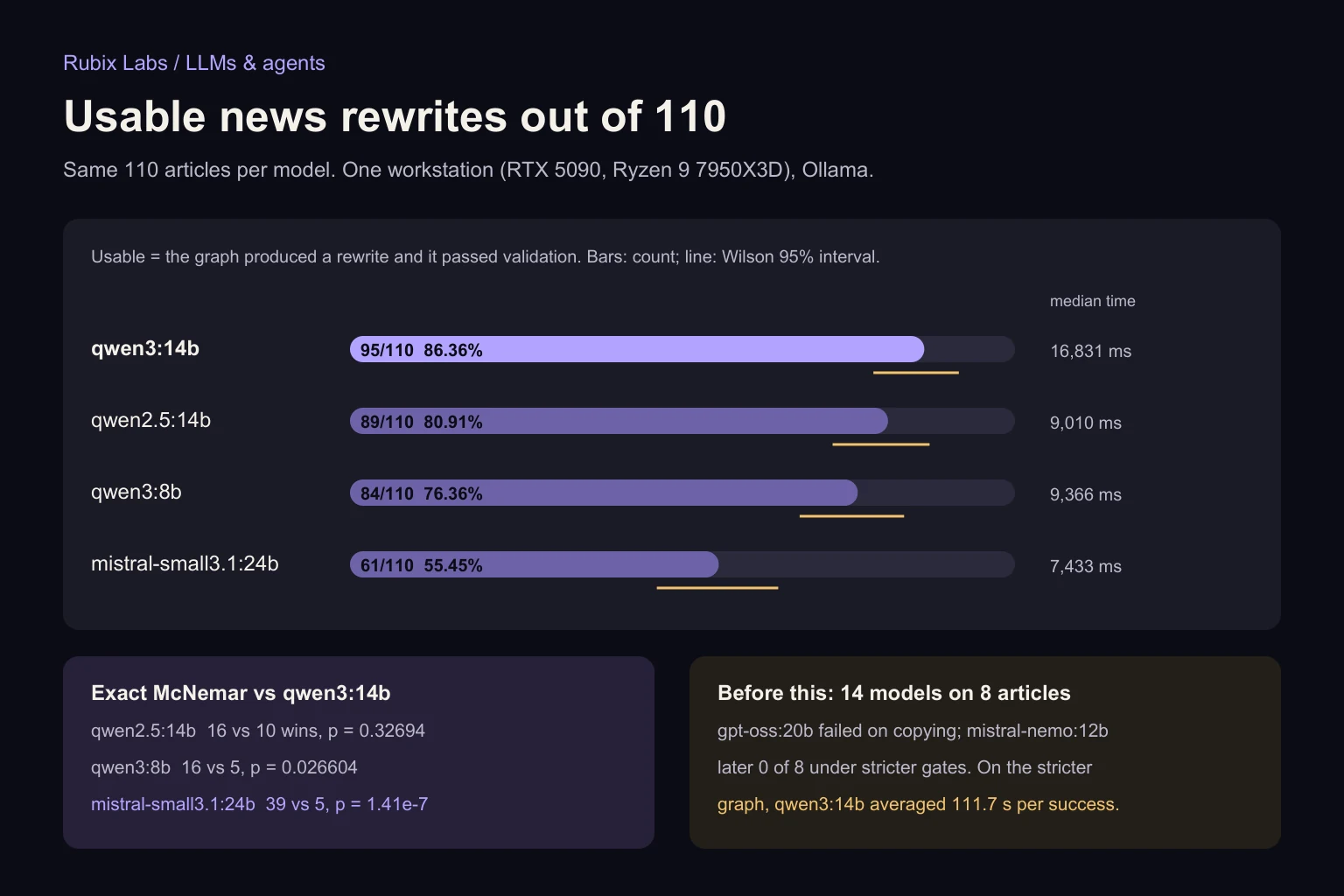
What counted as a usable rewrite
Every model ran inside the same LangGraph pipeline: fetch the page, extract the article with ordinary code (or with the model when that failed), rewrite it, then put the rewrite through the validation checks the pipeline itself uses. Those checks reject a rewrite that shares a long run of words with the source, quotes it, adds a number or time reference the article doesn't contain, drifts from the extracted facts, or comes out too short or cut off.
The primary measure in the 110-article study was the usable output, which our study notes define as generation succeeded and rewrite validation passed: the pipeline produced a rewritten article, and that rewrite passed the validation layer. It doesn't say whether a person would rate the summary as good. We planned human ratings for that and haven't run them.
Everything ran on one workstation with an AMD Ryzen 9 7950X3D, an NVIDIA RTX 5090 and 192 GB of RAM, using Ollama. We had no second hardware setup, so the timings describe this machine.
Screening 14 models on 8 articles
The first round gave each model the same 8 articles. Eight articles can rule a model out but can't separate close ones, so we used this round only to decide what deserved the larger run.
gpt-oss:20b is the one to look at if you're shopping for a summariser. Four of its six failures reused long phrases from the source and the other two quoted it. For a summary that has to be in its own words, that rules it out.
Four models went through: qwen3:14b as the leader, qwen2.5:14b as the fastest serious alternative, qwen3:8b as a realistic small baseline and mistral-small3.1:24b as a late challenger we wanted settled at scale. Size wasn't the rule: qwen2.5:32b and qwen3.5:27b had shown no gain for their footprint, and gemma3:27b did no better than the models that went through.
| Model | Usable of 8 | Mean time | What we saw |
|---|---|---|---|
| qwen3:14b | 7 | 16,681 ms | Strongest screened model |
| qwen2.5:14b | 7 | 26,181 ms | Best fallback candidate |
| qwen3:8b | 6 | 46,001 ms | Workable, weaker |
| gemma3:27b | 6 | 17,288 ms | The judge timed out on all six |
| gemma3:12b | 6 | 10,873 ms | Fast but brittle |
| mistral-small3.1:24b | 5 | 15,942 ms | Unresolved, so advanced |
| phi4:14b | 5 | 15,707 ms | Mid-pack |
| mistral-nemo:12b | 5 | 55,355 ms | Too slow for what it returned |
| qwen3.5:9b | 5 | 57,258 ms | Slow, no judged passes |
| qwen2.5:32b | 4 | 27,776 ms | Larger without a gain |
| gpt-oss:20b | 2 | 15,755 ms | Too close to the source wording |
| glm-4.7-flash | 2 | 43,609 ms | Six timeouts |
| qwen3.5:27b | 0 | n/a | Timeouts and fetch failures |
| command-r | 0 of 6 | n/a | Dropped after early failures |
The 110-article run
The second panel held 110 articles drawn from feed items we'd already stored, spread across nine source groups by quota and filtered to remove obvious non-news pages. Every finalist ran on all 110, so we could compare them article by article.
Paired against qwen3:14b with an exact McNemar test, mistral-small3.1:24b was clearly worse: qwen3:14b succeeded on 39 articles where it failed, and the reverse happened 5 times (p = 1.41 × 10⁻⁷). qwen3:8b was worse as well, 16 against 5 (p = 0.026604). qwen2.5:14b lost 16 to 10, and at p = 0.32694 the study can't separate the two.
Every finalist was faster than qwen3:14b on the articles both got through. qwen2.5:14b was faster on 60 of 79 shared successes, with a median saving of 4,294 ms (sign test p = 0.00000419), and it succeeded on 10 articles qwen3:14b missed. That's why it became our retry model.
The 24B model lost on copying. Of its 49 failures, 40 were bodies that reused long phrases from the source.
| Model | Usable of 110 | Rate | Wilson 95% interval | Mean / median time |
|---|---|---|---|---|
| qwen3:14b | 95 | 86.36% | 78.71% to 91.56% | 20,771 / 16,831 ms |
| qwen2.5:14b | 89 | 80.91% | 72.57% to 87.16% | 15,247 / 9,010 ms |
| qwen3:8b | 84 | 76.36% | 67.62% to 83.33% | 14,543 / 9,366 ms |
| mistral-small3.1:24b | 61 | 55.45% | 46.14% to 64.40% | 11,296 / 7,433 ms |
Slower once the pipeline got stricter
The 110-article study ran on an earlier, eight-node version of our graph. Over the next weeks we added claim planning, a verifier, repair branches and a final gate. In an April run on that stricter graph, qwen3:14b took a mean of 111.7 seconds per successful article (median 94.8 seconds), and 13 of 29 attempts succeeded. Six of those 13 came from the qwen2.5:14b retry.
Newer models struggled with that time budget. Gemma 4 26B timed out on all three articles it reached in one run, and in a rewrite-only rerun with a 32K context it timed out on two and rejected the third as a non-news page. Gemma 4 31B hit the 360-second article limit on the only article it reached. Those runs were cut short, so all they show is that neither model fit our time limits on this machine. On a fixed set of 8 articles in mid-April, mistral-nemo:12b passed none under the stricter checks, while qwen3:14b passed 5 and phi4:14b 3.
What we didn't measure
- Quality as a person would judge it. In the screening round, another local model graded the rewrites and timed out on 31 of the 60 it was given. That was too noisy to rank models with, so the 110-article study relied on validation alone.
- Human ratings. We wrote a blinded two-rater protocol for 30 to 50 articles comparing qwen3:14b and qwen2.5:14b. The rating sheet is still empty.
- Other hardware or hosted models. One workstation, one runtime and open-weight models only.
- A neutral corpus. The 110 articles came from our own stored feed items, and some are tech-adjacent features more than hard news.
What we'd run
On a workstation like this one, we'd run qwen3:14b first, send failed validations to qwen2.5:14b, and keep qwen3:8b for lower-stakes steps in the graph, away from the final rewrite. Ollama lists qwen3:14b at 9.3 GB with a 40K context window and qwen2.5:14b at 9.0 GB with 32K. The official model pages for Qwen3 14B and 8B, Qwen2.5 14B and Mistral Small 3.1 all list Apache 2.0.
Whatever you test, write the pass condition as code first and run every model on the same articles, so you can pair the results. Rubix runs this kind of comparison for custom model and agent work, and our pricing page lists LLM fine-tuning and AI agent work. We've also written up how four earlier versions of this pipeline went wrong.