LLMs & agents
Stopping AI news rewrites from copying their sources
In a research experiment, local models rewrote tech-news articles as short summaries in their own words. Fluent text was the easy part. Keeping the model from lifting long stretches of the source, or from adding a number or date the source never gave, took a set of checks around every model call. Across four models and a 110-article benchmark, 111 attempts didn't produce a usable rewrite. In 64 of them the body reused a long run of source wording, and another 24 added a number the source didn't contain.
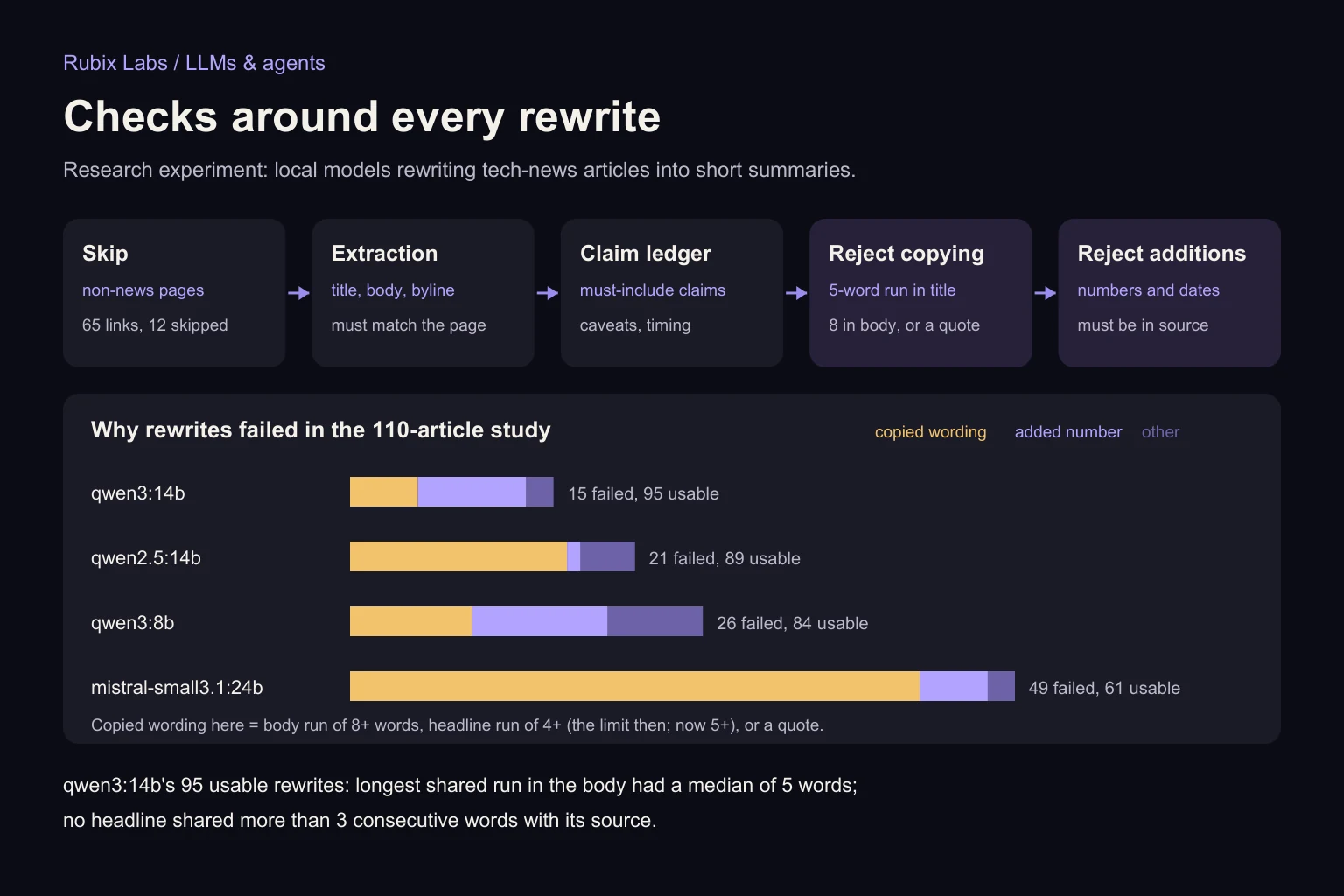
Skip pages that shouldn't be rewritten
The cheapest check runs before any model call. Rules on each feed item's title and URL skip how-to guides, reviews, deal roundups, newsletter digests, event promotions and video or podcast pages. In one run, 13 feeds offered 65 links; 12 were skipped as non-news and 53 queued. A second pass on the extracted page catches sponsored bylines, subscriber-only teasers and sponsored explainers that the URL didn't give away.
One security news site sometimes returned a bot-challenge page instead of the article. The extractor recognises that page and marks the link as a terminal failure, so the queue doesn't retry it and no model gets asked to summarise a challenge screen.
Check the extraction before rewriting anything
Ordinary code extracts the headline, body, byline and date, and the result has to match the page before anything else happens. A headline the page text doesn't support fails with the error 'Title not supported by source text'. The retry policy treats that as terminal, since fetching the same page again won't change the answer. The body has to be long enough, read like an article, carry no site boilerplate and open with words that come from the page, and a byline has to appear on the page too.
When code extraction fails these checks, a model extracts the article and the same checks run on its output. With qwen3:14b in the 110-article run, 21 articles needed that fallback, and 19 of them had failed on the byline.
Plan the claims before writing the summary
Before the rewrite, a planning call turns the extracted article into a claim ledger: short, checkable statements marked primary or secondary, with the must-include claims, caveats and timing details flagged. The planner works from this article only. Similar headlines from other outlets count as background, and relative dates such as last week stay relative instead of becoming calendar dates.
The writer works from the ledger. Afterwards a verifier maps each sentence of the rewrite back to it and quarantines the rewrite if it misses too many required claims, drops a required caveat or adds context the ledger can't support. Dense security, legal and research stories get a stricter bar. A quarantined rewrite goes through repair and narrower recovery branches before the article is marked as failed.
The copying and embellishment rules
After each rewrite, a validator compares the new headline and body with both the extracted article and the raw page text. It rejects the rewrite if the headline shares a run of five or more consecutive words with the source, or the body shares a run of eight or more. Both sides are lowercased and stripped of punctuation first, so moving a comma doesn't rescue a copied sentence. During the 110-article study the headline limit was four words; we relaxed it to five later.
Quotation marks anywhere in the body fail it as well. A quote is source wording by definition, and in a short summary we'd rather paraphrase than vouch for every quotation.
The other rules catch additions. Every number in the rewrite has to appear in the source. That rule is blunt: it compares digits, so writing 3 where the article spelled out three fails too. Relative time phrases such as next month, and dates written as a month and day, have to appear in the source. So do phrases that add doubt or significance the article didn't express, such as calling someone undisclosed or unnamed, saying a claim wasn't independently verified, or calling a story a potential turning point.
If the body passes and only the headline is too close, the graph retries the headline on its own, so one copied phrase in a headline doesn't cost a good summary.
What the checks caught
In the 110-article study, four local models rewrote the same articles. The table shows why an attempt didn't produce a usable rewrite.
Copied wording was the main failure for qwen2.5:14b and mistral-small3.1:24b. Both Qwen3 models more often added a number the source didn't contain. One qwen3:14b reply failed for a stranger reason: instead of a rewrite, it restated its instructions in Chinese.
Among qwen3:14b's 95 usable rewrites, the body's longest run shared with the source had a median of five words, and no headline shared more than three consecutive words with its source.
| Reason | qwen3:14b | qwen2.5:14b | qwen3:8b | mistral-small3.1:24b |
|---|---|---|---|---|
| Body shared a run of 8+ words with the source | 4 | 14 | 6 | 40 |
| Number not found in the source | 8 | 1 | 10 | 5 |
| Headline shared a run of 4+ words | 1 | 2 | 3 | 1 |
| Body quoted the source | 0 | 0 | 0 | 1 |
| Extraction, length or shape checks | 1 | 4 | 2 | 2 |
| Timeout or unreadable reply | 1 | 0 | 5 | 0 |
| Usable rewrites | 95 | 89 | 84 | 61 |
Completeness is the harder problem
A summary can pass every copying rule by saying less. Our notes after the April runs said as much: the biggest remaining quality gap was completeness and precision on dense security, legal and long-form stories, more than copying. In one April run on the stricter graph, the run summary lists 15 failed links in detail. Six were quarantined for missing required claims or caveats, and one for reusing long source phrases.
After we added salvage and context-pruning branches, a set of four hard stories went from two usable rewrites to four. Four stories is a smoke test. The ideas in our notes for closing the gap are claim extraction section by section for long stories, coverage quotas by claim type (one legal-posture detail and one mitigation detail when the source has them, for example), and checking each summary sentence against one or two ledger claims. We haven't measured whether they close it, and the human rating we planned hasn't been run either.
What these checks don't do
A shared-word limit catches copied phrasing. It doesn't decide plagiarism or anything legal. A rewrite can follow a source's structure and order of ideas with every word changed and still pass, and the rules only compare the rewrite with the one article it came from.
Rubix builds checks like these into document and AI workflows, where a model's output is accepted only after code has compared it with its source. Our article on prompt injection in document AI covers the input side of the same problem, the agentic systems page explains how we scope that work, and the pricing page lists the starting points.