InsurTech
ACORD 25: how to read a certificate of insurance
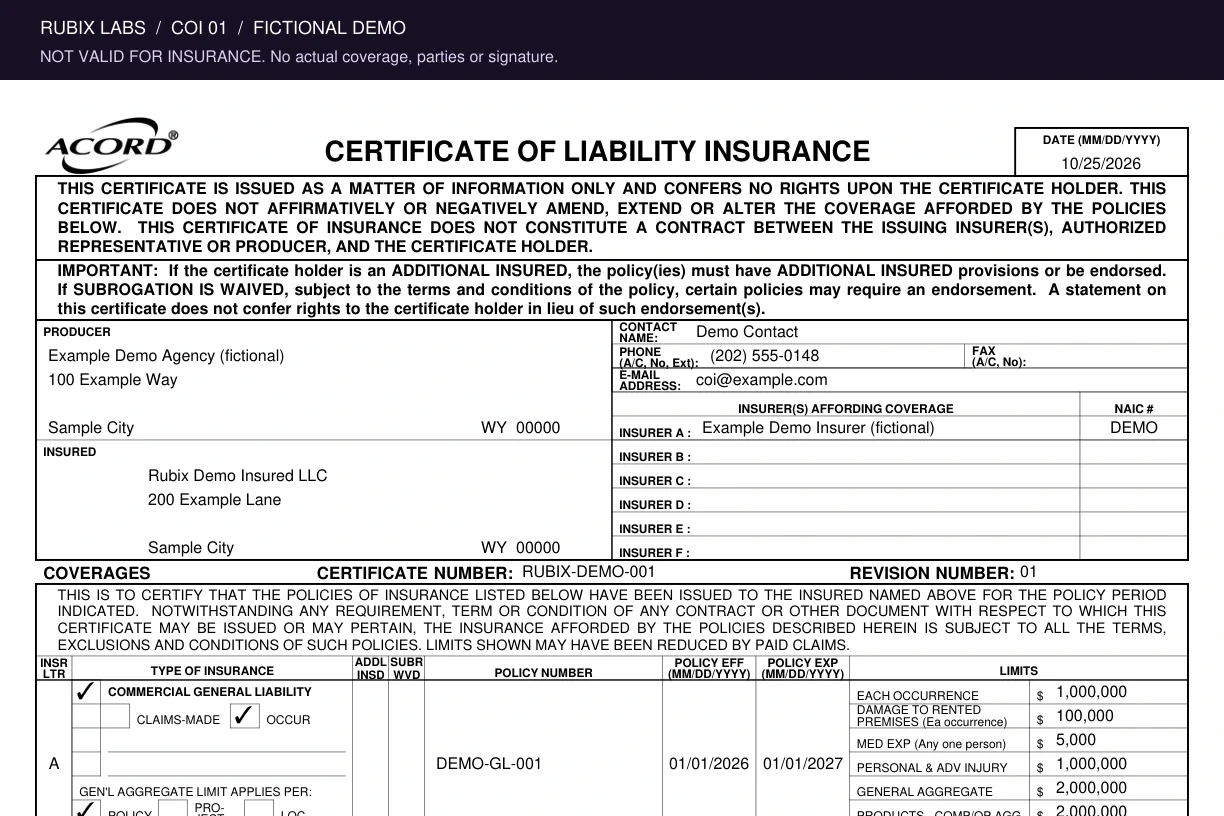
An ACORD 25 is a one-page summary of liability policies that an agent or broker issues to a third party, the certificate holder. It shows the insurers, policy numbers, dates and limits the producer reports as in force on the day it was issued. It doesn't change those policies, give the holder any rights or make the holder an additional insured, and the form says so at the top. Read it as evidence to check against your requirements, not as coverage.
Read the two boxes everyone skips
The first box says the certificate is issued as a matter of information only and confers no rights upon the holder. It doesn't affirmatively or negatively amend, extend or alter the coverage of the policies listed, and it isn't a contract between the insurers, the producer and the holder.
The second, marked IMPORTANT, covers the two things holders most often want. If the holder is an additional insured, the policies must have additional insured provisions or be endorsed. If subrogation is waived, some policies may require an endorsement. A statement on the certificate doesn't confer rights in place of those endorsements. Regulators make the same point: the Texas Department of Insurance, for example, explains that a certificate can't alter the policy it describes.
Producer, insured, holder and insurer letters
The producer is the agency issuing the certificate, with a named contact. The insured is the policyholder. The certificate holder, at the bottom left, is whoever asked for the certificate: a customer, a landlord, a lender. Holder and insured are different parties, and being the holder gives no coverage by itself.
Insurers are listed as A to F with NAIC numbers. Each coverage row has an INSR LTR column pointing back to one of them, so you can see which company writes which policy. Check the insured's name against the contract you hold; a trading name or a sister company is a question to ask, not a match to assume.
The date at the top is the issue date, and the certificate and revision numbers identify this version. The revised certificate at the end of our policy change demo, for example, is revision 02.
The coverage rows, column by column
Each row lists a type of insurance, the ADDL INSD and SUBR WVD boxes, the policy number, effective and expiry dates, and limits. The paragraph above the rows adds one more caveat: limits shown may have been reduced by paid claims. A certificate shows policy limits, not what's left of them.
| Row | What to read |
|---|---|
| Commercial general liability | Claims-made or occurrence; each occurrence, damage to rented premises, medical expense, personal and advertising injury, general aggregate, and products and completed operations aggregate; whether the aggregate applies per policy, project or location. |
| Automobile liability | Any auto, owned, scheduled, hired or non-owned autos; a combined single limit or separate bodily injury and property damage limits. |
| Umbrella and excess | Occurrence or claims-made, each occurrence and aggregate, and any deductible or retention. |
| Workers compensation and employers' liability | Per statute or other; E.L. each accident, disease per employee and disease policy limit; whether any proprietor, partner or executive officer is excluded. |
| Description of operations | Free text about operations, locations or vehicles, with an ACORD 101 attached if more room is needed. |
A tick in ADDL INSD isn't an endorsement
The ADDL INSD and SUBR WVD columns are where the producer marks that additional insured status or a waiver of subrogation applies to a policy. Read them with the IMPORTANT box in mind. The rights come from the policy and its endorsements, so when your contract requires either, ask for the endorsement or the relevant policy wording and have someone qualified review it.
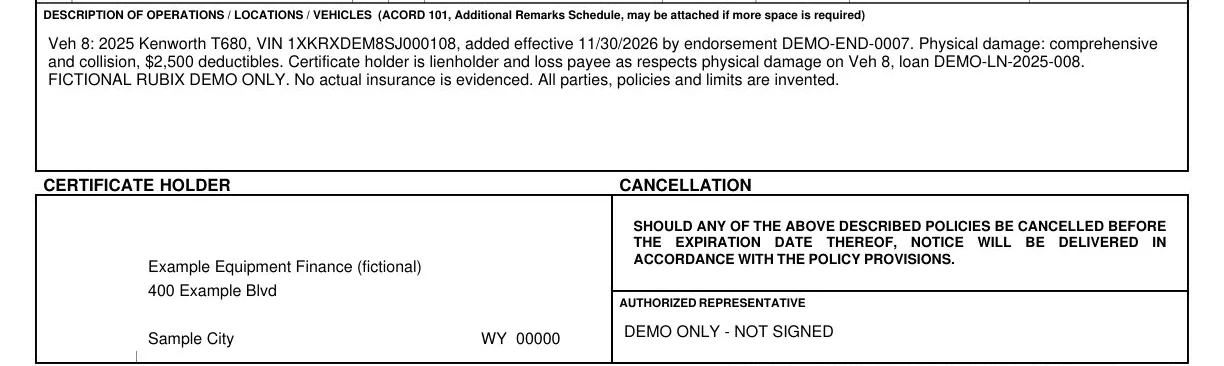
The description box works the same way. In our policy change demo, the revised certificate names the lender as lienholder and loss payee for one vehicle and cites the endorsement that added it. The certificate reports the change; the endorsement made it.
We're describing the form here, not giving coverage advice. Whether a particular endorsement satisfies a particular contract is a question for whoever is responsible for your insurance requirements.
What a certificate can't tell you
It can't tell you the policy is still in force today. The cancellation box says that if a listed policy is cancelled before its expiration date, notice will be delivered in accordance with the policy provisions. That points to the policy; it isn't a promise that the holder will hear about it. Track expiry dates and ask for a fresh certificate at renewal.
It can't tell you the full limit is still available, because paid claims may have reduced it. And it can't make up for missing evidence. An empty limit cell is missing information, not a zero, and a blurry scan is a reason to ask for a clearer copy, not to fail the vendor.
Checking hundreds of them
If you collect certificates from carriers, vendors or subcontractors, reading them turns into a rules problem: which coverage rows each relationship needs, minimum limits, acceptable dates and named insureds, and which questions go to a person. Rubix's COI compliance demo lets you submit three fictional ACORD 25s, see them checked against editable requirements and review an uncertain field in the admin view. Our COI tool guide covers how we'd build that workflow for real.
The AI agents demo ends with a revised ACORD 25 after a carrier confirms a mid-term change. That's the order we'd always keep: endorsement first, certificate second.