InsurTech
ACORD 175: a change request isn't the change
The ACORD 175 is the form an agency uses to ask a carrier to change a commercial policy mid-term: add a vehicle, remove a driver, change a location, list a lienholder or adjust limits on other lines. It's a request, and it says so. The form calls itself an acknowledgement of the request and says the company's records will be adjusted upon approval, with any premium adjustment made at audit or by endorsement. Until the carrier confirms the change, it hasn't happened, whatever anyone has told the customer.
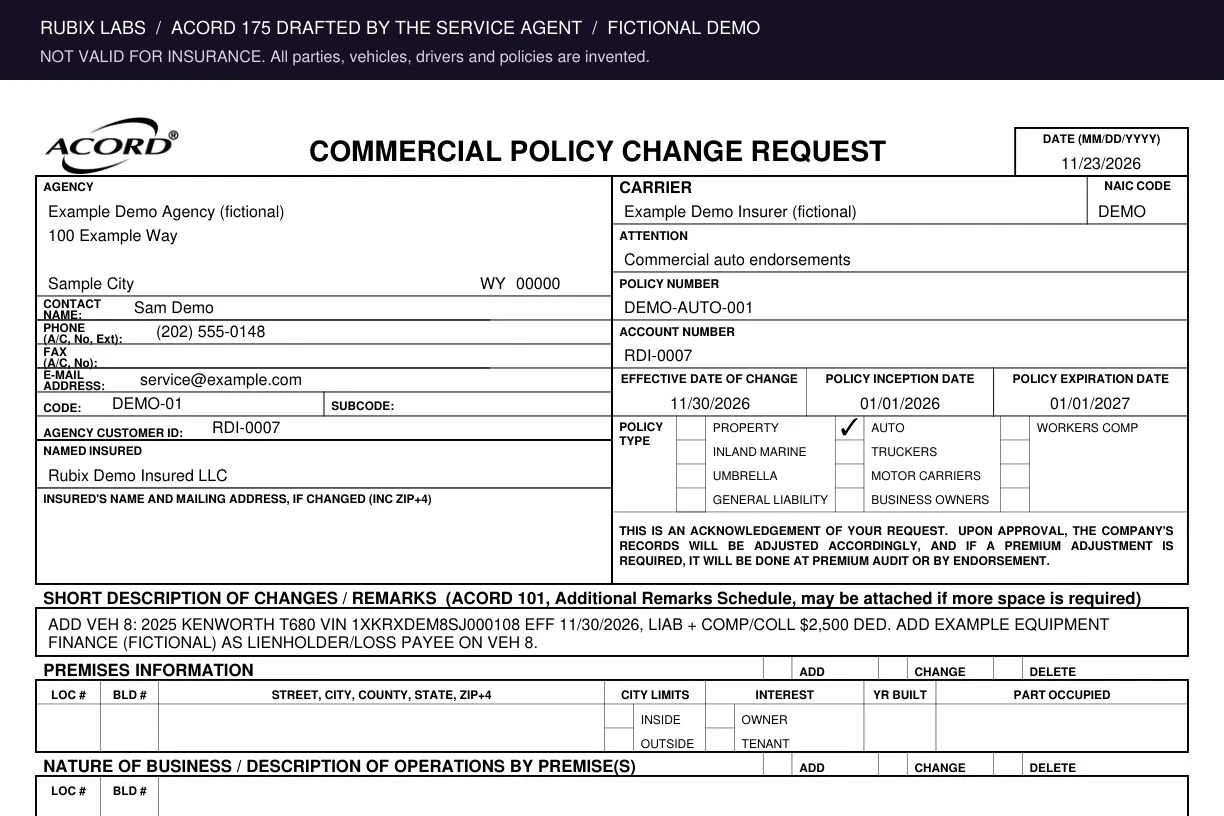
The header: which policy, which date
The top of page 1 identifies the agency, the carrier with an attention line, the policy number and account number, and three dates: the effective date of change, the policy inception date and the expiration date. Policy type has boxes for property, inland marine, umbrella, general liability, auto, truckers, motor carriers, business owners and workers compensation. Below the named insured there's a separate field for a changed name or mailing address.
The effective date of change is the date the insured is asking for. The carrier's endorsement is what confirms it. In our demo, the request asks for 11/30/2026 on policy DEMO-AUTO-001, and everything before the carrier's answer treats that as a requested date.
What each section can add, change or delete
A short description of the changes goes near the top, with the ACORD 101 for more room. After that, each section has its own add, change and delete boxes, so you fill in only the sections the change touches. Most of page 2 is for other lines: workers compensation, property, inland marine, general liability and umbrella.
| Section | What it covers |
|---|---|
| Premises information | Location, building, address, city limits, owner or tenant, year built and part occupied. |
| Nature of business by premises | The operations at each location. |
| Auto-vehicle description and limits | Two vehicle blocks with the same fields as the ACORD 127, plus liability, no-fault, medical payments and uninsured and underinsured motorist limits, and a box for changed policy limits. |
| Driver information | Driver rows, headed 'List drivers who frequently use own vehicles'. |
| Workers compensation | State, location, class code, employees and estimated annual remuneration. |
| Property and inland marine | Subject of insurance, amounts, valuation, causes of loss, building details and scheduled equipment. |
| General liability and umbrella | Changed limits and the schedule of hazards; the umbrella limit and retained limit. |
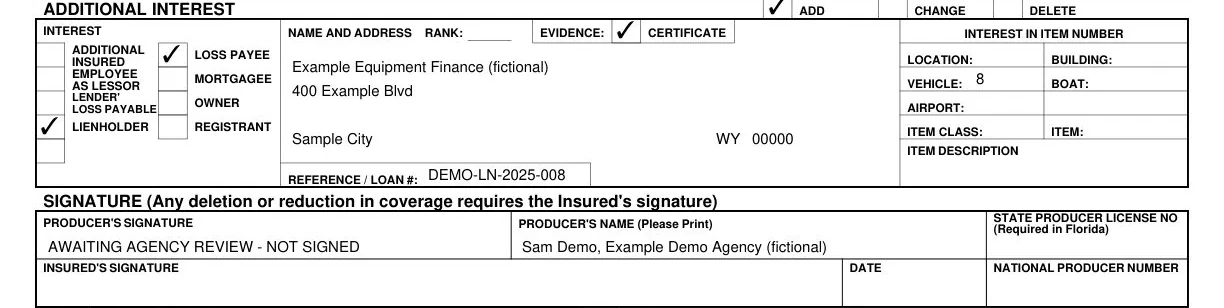
| Additional interest | Lienholder, loss payee, mortgagee, additional insured and others, tied to a location, vehicle or item. |
A worked change: one more truck
In our demo, a fictional trucking company asks to add a 2025 Kenworth T680 from 30 November, financed by a fictional lender. The service agent records the request first and gives it a reference. Then it asks for what's missing, the garaging ZIP and the gross vehicle weight. Only then does it draft the 175: vehicle 8 with its VIN, garaging, radius and cost new; liability plus comprehensive and collision with USD 2,500 deductibles; and, on page 2, the lender as lienholder and loss payee with its loan number.
The draft then waits for a person at the agency. The page 2 signature block notes that any deletion or reduction in coverage requires the insured's signature. Adding a truck isn't a reduction, but somebody authorised still has to check the vehicle against its registration, confirm the use boxes match the rest of the fleet, then sign and send it. That step belongs to the producer, not the agent.
Received, sent and done are different states
Mid-term changes go wrong in the gap between asking and confirmation. The customer asks whether the new truck is covered. Someone sees that the 175 went out and says yes. Meanwhile the carrier hasn't processed it, or has a question, or its system is down. Now the customer is driving a truck they believe is insured.
We'd give each state a name and tie it to evidence, so nobody can report a stage the records don't support. These are the stages in Rubix's demo.
| State | Evidence behind it | What the customer can be told |
|---|---|---|
| Request received | A reference and the original message | We've recorded your request. Nothing has changed on the policy yet. |
| Information missing | The specific fields still needed | Here's exactly what we need before your agency can review it. |
| Agency review pending | A drafted 175, not signed or sent | It's with your producer. The date is the one you asked for, not a confirmed date. |
| With the carrier | The 175 sent; no endorsement yet | Your agency sent it. The carrier hasn't confirmed it, so the truck isn't on the policy yet. |
| Unable to complete yet | A recorded failure and a named owner | We can't finish it right now; here's who is following it up. |
| Confirmed by carrier | The endorsement number and documents | It's on the policy from the confirmed date. Here's the revised certificate. |
After the endorsement, update the certificates
Once the carrier confirms, anything issued from the old version may need reissuing. The lender in our demo needs evidence that it's listed, so the flow ends with a revised ACORD 25: revision 02, with the lender as certificate holder and a description naming vehicle 8, its VIN and endorsement DEMO-END-0007. That certificate comes after the endorsement, not before it, and it still doesn't change the policy. The endorsement did that.
If you're building or buying software for policy changes, test the unhappy paths: the carrier rejects the request, asks for something else, or confirms a different effective date. Rubix can help put that state model and the drafting around your agency's existing systems, with a person on every step that commits the insured.