InsurTech
ACORD 127 and 129: business auto drivers and vehicles
The ACORD 127 is the business auto section that goes with an ACORD 125. Its four pages hold a 13-row driver table, general information questions 1 to 17, four vehicle blocks and the signatures. Coverages and limits go on the state ACORD 137, and when a fleet has more than four vehicles, an ACORD 129 vehicle schedule carries five more per page. Most of the questions an underwriter sends back on a truck submission start on these pages: a VIN that fails its check digit, a truck garaged at an address nobody listed, a filing with no ACORD 194, or a vehicle count that disagrees with the email.
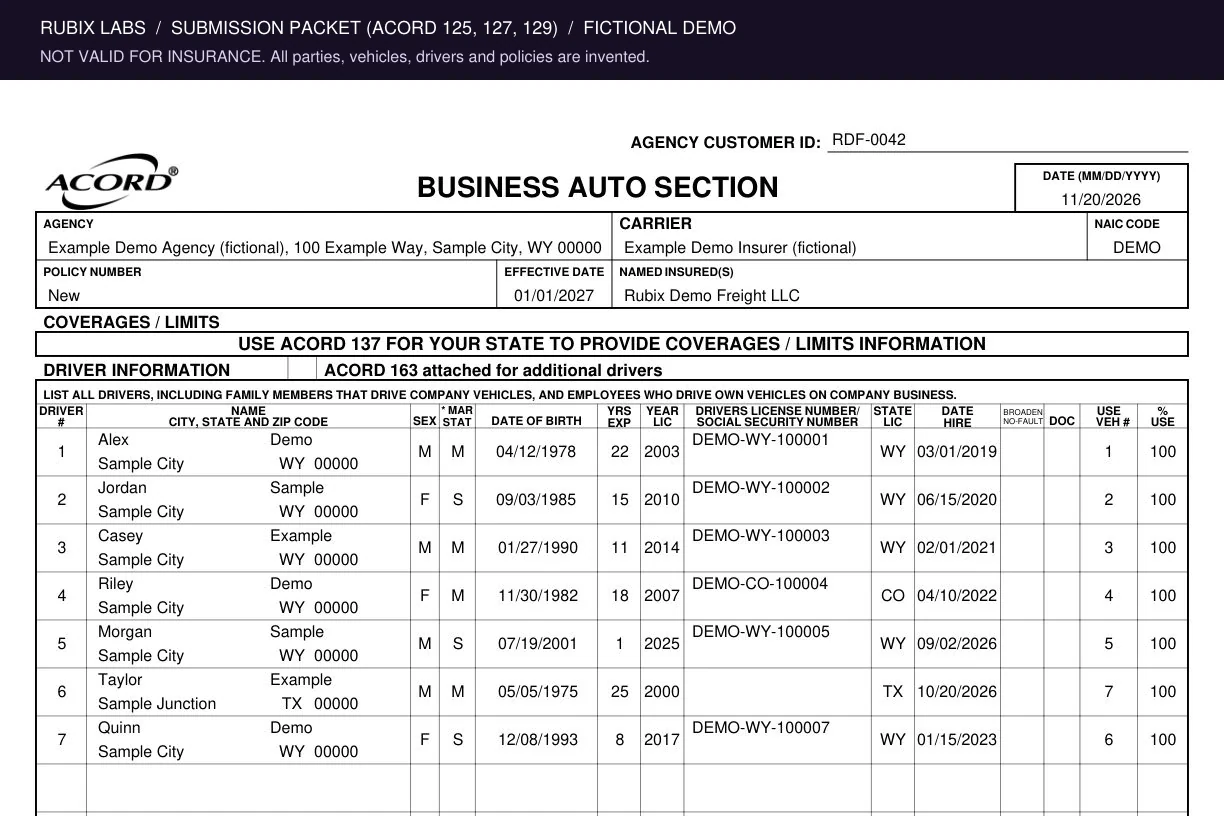
The driver table, and the missing licence number
Page 1 lists drivers: name and address, sex, marital status, date of birth, years of experience, year licensed, licence number, licensing state, date of hire, the vehicle each one mainly uses and the percentage of use. The instruction above it is broad: list all drivers, including family members who drive company vehicles and employees who drive their own vehicles on company business. If thirteen rows aren't enough, there's a box for an attached ACORD 163.
The most common gap is the simplest. In the demo packet, driver 6 was hired in October 2026, is licensed in Texas and has no licence number. Without it, nobody can order a motor vehicle record. While you're there, check that each 'use veh #' points to a vehicle that's actually scheduled, and that years of experience fit the year licensed.
Questions 1 to 17
The general information questions run from the bottom of page 1 onto page 2, answered Y or N with an explanation for every yes. A few carry attachments or tables of their own, and question 14 includes a Kansas note about minor speeding violations that don't have to be reported there.
| Question | What it asks |
|---|---|
| 1 | Apart from encumbrances, are any vehicles not solely owned by and registered to the applicant? |
| 2 to 5 | Employees using their own autos; a vehicle maintenance program; vehicles leased to others; modified vehicles or special equipment. |
| 6 | Are ICC, PUC or other filings required? If yes, attach an ACORD 194. |
| 7 | Do operations involve transporting hazardous material? |
| 8 to 12 | Hold harmless agreements; vehicles used by family members; MVR verifications; a driver recruiting method; drivers not covered by workers compensation. |
| 13 | Any vehicles owned but not scheduled on this application? |
| 14 | Any drivers with convictions for moving traffic violations? A table records driver, date, type and place. |
| 15, 16 | Has the agent inspected the vehicles; are all of them part of a fleet? |
| 17 | Electronic monitoring devices: what share of the fleet, and what they're used for, from driver safety to location tracking. |
Four vehicles on the 127, five per page on the 129
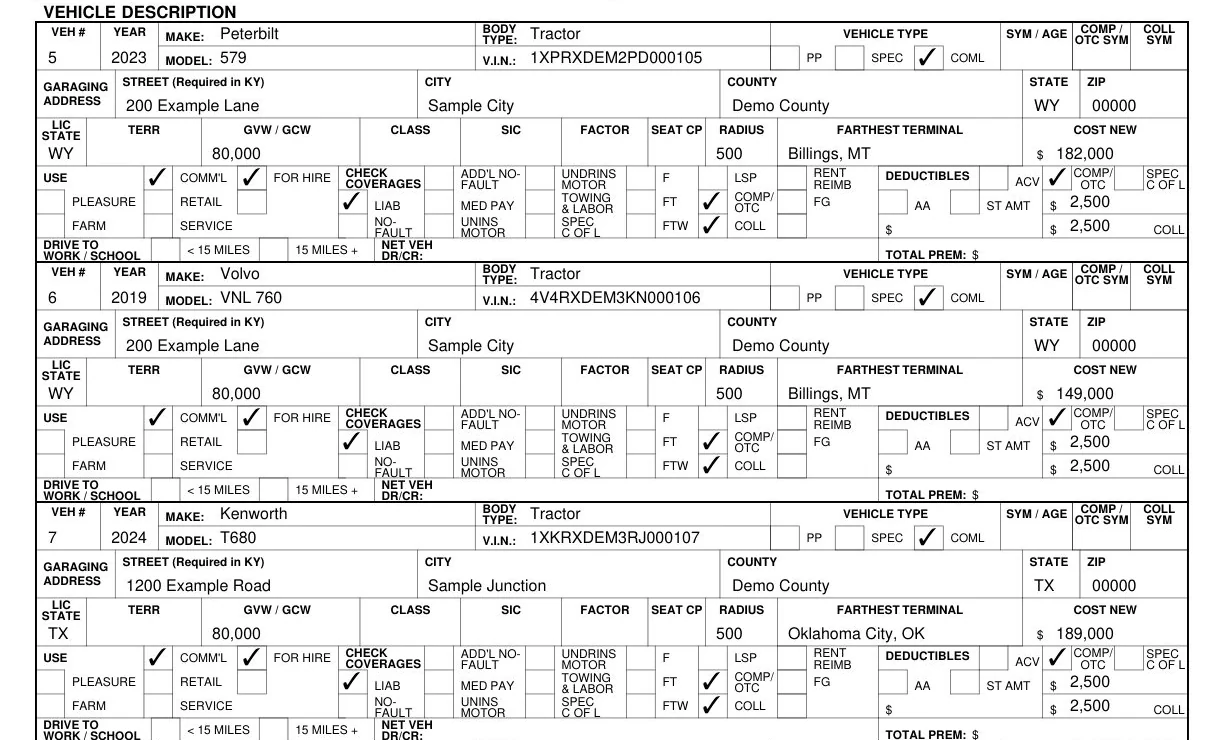
Page 3 of the 127 holds four vehicles, with a box to tick when an ACORD 129 is attached for more. Each block has year, make, model, body type and VIN; vehicle type; garaging address (the street is marked as required in Kentucky); licensing state, territory, GVW or GCW, class, radius and farthest terminal; cost new; use, from commercial and for hire to pleasure and farm; the coverages requested; and deductibles.
The ACORD 129 (2009/11) repeats the same block five times on a page, under its own header with the agency, carrier, policy number, effective date and named insured. Those header fields should match the 127. In the demo packet, vehicles 1 to 4 sit on the 127 and vehicles 5 to 7 on the 129.
Check the VIN before anyone else does
A 17-character VIN for the US market has a check digit in position 9. It's calculated from the other 16 characters: letters are converted to numbers, each position is multiplied by a fixed weight, and the remainder after dividing the total by 11 gives the digit, with 10 written as X. The letters I, O and Q aren't used. The rules are in 49 CFR Part 565.
That makes a cheap first check. It catches most single-character typos, though not every error, and it says nothing about whether the VIN belongs to that truck. In the demo packet, vehicle 4's VIN ends in 000140 and fails: position 9 says 5 and the calculation gives 9. Read the serial as 000104, in line with the other trucks, and it passes, so a transposition is likely. Still ask for the registration instead of fixing it yourself.
Rubix's demo runs this check in the browser on every scheduled VIN. It's a few lines of code, and it's exactly the kind of rule we'd keep in code rather than ask a model to judge.
Garaging, vehicle count and filings
Garaging affects territory and state rating, so compare every garaging address with the premises on the ACORD 125. In the demo, vehicle 7 is garaged at a yard in Sample Junction, Texas. The 127's description of garage locations mentions that yard; the 125 lists only the Sample City, Wyoming premises. Ask whether the location should be added.
Then count. The broker's email says 6 power units; the 127 and 129 schedule 7, and question 13 says no owned vehicles are left off. One of those is wrong, and only the applicant knows which. Ask which vehicles to quote.
Question 6 is easy to miss. It's answered Y, so the form asks for an ACORD 194, and the packet doesn't include one. Request it with the USDOT and MC numbers and the filing types needed. The conviction table under question 14 and the driver experience column are notes for the underwriter; whether a driver is acceptable is the carrier's call under its own guidelines.
Try the checks on a filled packet
Rubix's submission intake demo uses a real ACORD 125, 127 and 129 filled with fictional data. It reads the email and the forms, runs the checks in this guide, links each finding to its field and drafts a reply asking only for what's actually missing. The extraction is prepared in advance and the premium stays blank.
If your agency or MGA rekeys business auto submissions, send us a fictional packet and the questions your underwriters ask most often. We can help decide which checks run as code, which go to a person, and how the brief reaches the system your team already works in.