InsurTech
ACORD 125: the commercial application, page by page
The ACORD 125 is the common front sheet of a commercial insurance submission. Its four pages cover who the applicant is, which lines and attachments are included, where the business operates, a block of general underwriting questions, prior carriers, losses and signatures. It doesn't describe the fleet or the building in detail; line sections such as the ACORD 127 do that. Most of the questions an underwriter sends back start where the 125 disagrees with those attachments or with the broker's covering email.
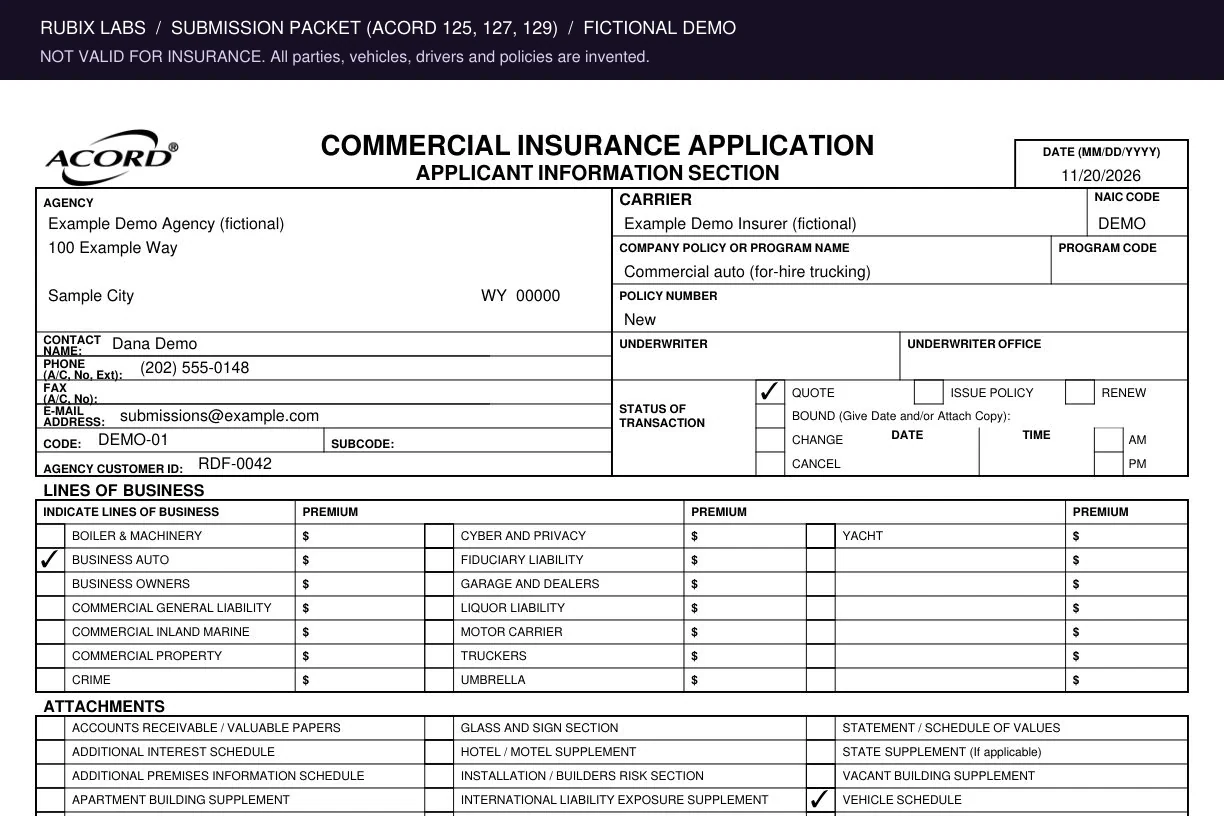
Page 1: who's asking, for what, with which attachments
The top of page 1 identifies the agency, the carrier and its NAIC code, the policy or program name and the status of the transaction: quote, issue policy, renew, bound, change or cancel. Then come two checklists. Lines of business lists the coverages requested, each with a premium column. Attachments lists the supplements that should travel with the form, from a vehicle schedule to a contractors supplement.
Treat every tick as a promise about the packet. If Business Auto is ticked, someone will look for the business auto section; if Vehicle Schedule is ticked, they'll expect the schedule. In our demo packet both are there. Check that first, because one missing supplement can hold up the whole submission.
Policy information gives the proposed dates, billing and payment plans, deposit and premiums. Applicant information carries the first named insured, mailing address, GL code, SIC, NAICS, FEIN and entity type, with room for other named insureds. The named insured should read the same way on every form in the packet; an LLC on the 125 and a trading name on the 127 is a question waiting to happen.
Page 2: premises, operations and interests
Page 2 starts with contact information, then up to four premises: address, city limits, owner or tenant, employees, annual revenues, building areas and any area leased to others. The ACORD 823 takes more locations.
Nature of business has tick boxes from apartments to wholesale, an 'other' line, the date the business started and a free-text description of primary operations. That description gets read closely. Ours describes a regional for-hire carrier hauling dry van freight within a 500-mile radius, with no hazardous materials. Both claims can be checked against the auto section: the radius on each vehicle, and question 7 of the ACORD 127, which asks about hazardous material.
The page ends with an additional interest block, with the ACORD 45 for more. The ACORD 127 has its own block tied to a vehicle number, which is where our demo's lienholder sits.
Page 3: the general information questions
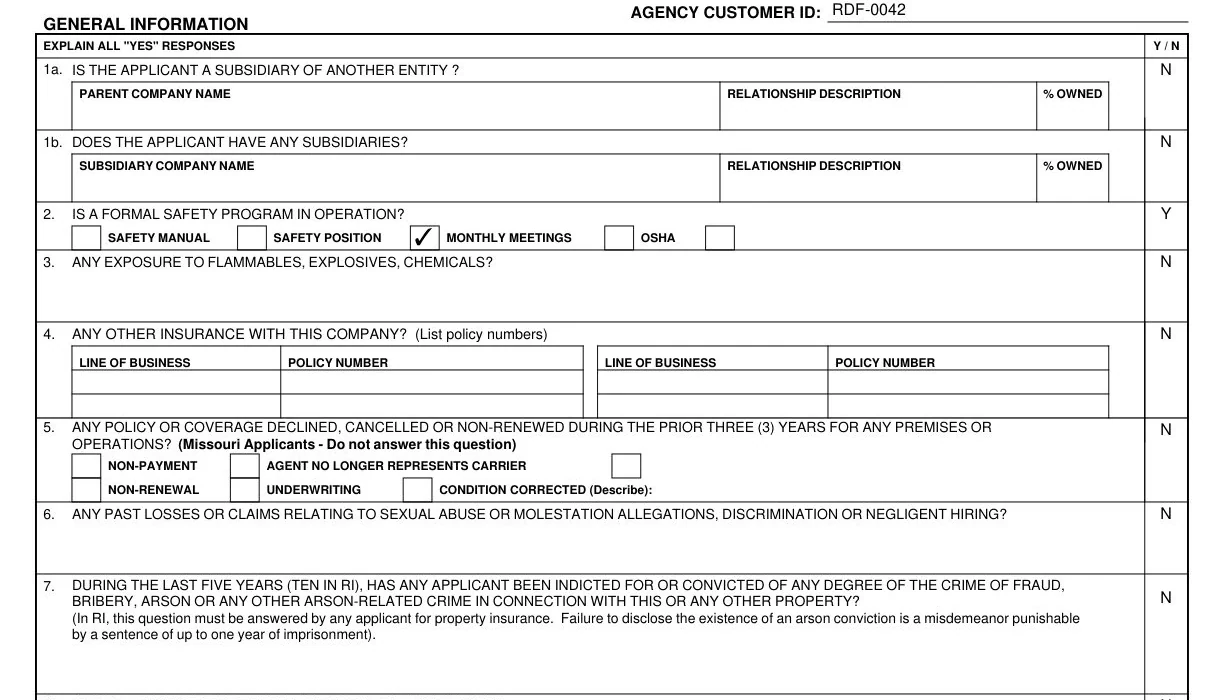
Page 3 holds the underwriting questions, numbered 1a to 15. Each is answered Y or N, and the form asks for an explanation of every yes. They look short, but several carry their own conditions. Question 5 has boxes for the reason and a note that Missouri applicants shouldn't answer it. Question 7 looks back five years, or ten in Rhode Island.
| Question | What it asks |
|---|---|
| 1a, 1b | Is the applicant a subsidiary of another entity; does it have subsidiaries? |
| 2 | Is a formal safety program in operation (safety manual, safety position, monthly meetings, OSHA)? |
| 3 | Any exposure to flammables, explosives or chemicals? |
| 4 | Any other insurance with this company? List the policy numbers. |
| 5 | Any policy or coverage declined, cancelled or non-renewed in the prior three years for any premises or operations, and why? |
| 6 | Any past losses or claims relating to sexual abuse or molestation allegations, discrimination or negligent hiring? |
| 7 | Has any applicant been indicted for or convicted of fraud, bribery or an arson-related crime in the last five years (ten in RI)? |
| 8 to 10 | Uncorrected fire or safety code violations; foreclosure, repossession or bankruptcy; a judgement or lien in the last five years. |
| 11 to 13 | Business placed in a trust; foreign operations or products (attach ACORD 815 or 816); other ventures for which coverage isn't requested. |
| 14, 15 | Does the applicant own, lease or operate drones, or hire others to operate them? |
Prior carriers and loss history
Prior carrier information starts at the bottom of page 3 and continues on page 4: for each year, the carrier, policy number, premium and dates, split into general liability, automobile, property and other. In the demo packet, the expiring auto policy runs 01/01/2026 to 01/01/2027 and the proposed effective date is 01/01/2027, so the dates line up. A gap or an overlap there deserves a question before the underwriter asks it.
Loss history asks for all claims or losses, regardless of fault and whether or not insured, plus occurrences that may give rise to claims, over a number of years the agent fills in. There's a 'Check if none' box. Compare it with the carrier's loss runs when you have them: a ticked 'none' beside a loss run full of claims is an awkward thing for someone else to find first.
The prior premium is context for the underwriter. It isn't a quote, and nobody should price from it.
Where the 125 disagrees with the rest of the packet
Underwriters read the 125 alongside everything else in the submission. These are the mismatches we'd check before sending it, using the fictional demo packet as the example. They're questions to settle with the applicant, not conclusions about the risk.
| Check | In the demo packet | What to do |
|---|---|---|
| Question 5 against the email | The email says the current carrier is non-renewing; question 5 is answered N. | Ask for the facts and the reason, then correct the application. The answer is the applicant's to give. |
| Premises against garaging | Vehicle 7 is garaged in Sample Junction, TX; the only premises listed are in Sample City, WY. | Ask whether the Texas yard should be added as a location. |
| Operations against the auto section | A 500-mile radius on page 2, and 500 on every vehicle block. | Make sure the description, radius and farthest terminals tell the same story. |
| Losses against loss runs | One at-fault auto loss listed, USD 18,250 paid. | Compare with the carrier's loss runs when they arrive. |
Page 4: what the signatures represent
The signature block has a notice of information practices, state fraud warnings and a statement that the signer, an authorised representative of the applicant, has made reasonable inquiry and believes the answers are true, correct and complete. The producer signs too.
That representation matters when software fills in the form. An agency system or an AI agent can prefill a 125 from last year's submission, but the answers still belong to the applicant. We'd have the applicant confirm anything that changed, and look again at the yes-or-no questions on page 3 instead of carrying last year's N forward.
Try it on a filled 125
Rubix's AI agents page has a submission intake demo built on a real ACORD 125 (2016/03), ACORD 127 (2015/12) and ACORD 129 (2009/11), filled with fictional data. The agent reads the broker's email and the three forms, runs checks like the ones above, links each finding to the field it came from and drafts the reply. The extraction is prepared in advance, and the premium stays blank: only a carrier's quoting system supplies a number.
If your team retypes ACORD forms into an agency or carrier system, bring us a fictional packet and the questions you usually send back. We can work out with you which checks belong in code and which stay with your underwriters.