LLMs & agents
LLM fine-tuning negative results and fresh vs seen test scores
In a research experiment, we built a local insurance assistant prototype on one workstation and kept a ledger where every failure stays as written. Plenty of it didn't work, or worked less well than it first looked. The one fine-tuning result that held up, a narrow extraction adapter, has its own write-up. This is the rest: a small LoRA that made things worse, a knowledge test whose best-looking score means the least, and a 22-question comparison where a perfect rerun turned out to be a routing check.
A 0.6B LoRA that went from 2/16 to 0/16
We started small, with Qwen3-0.6B. A first smoke run on seven synthetic examples proved the training pipeline worked and nothing more; its mean token accuracy was 0.4061. The expanded LoRA trained on 80 synthetic cases in 254.6 seconds, with 16 cases held out by task family.
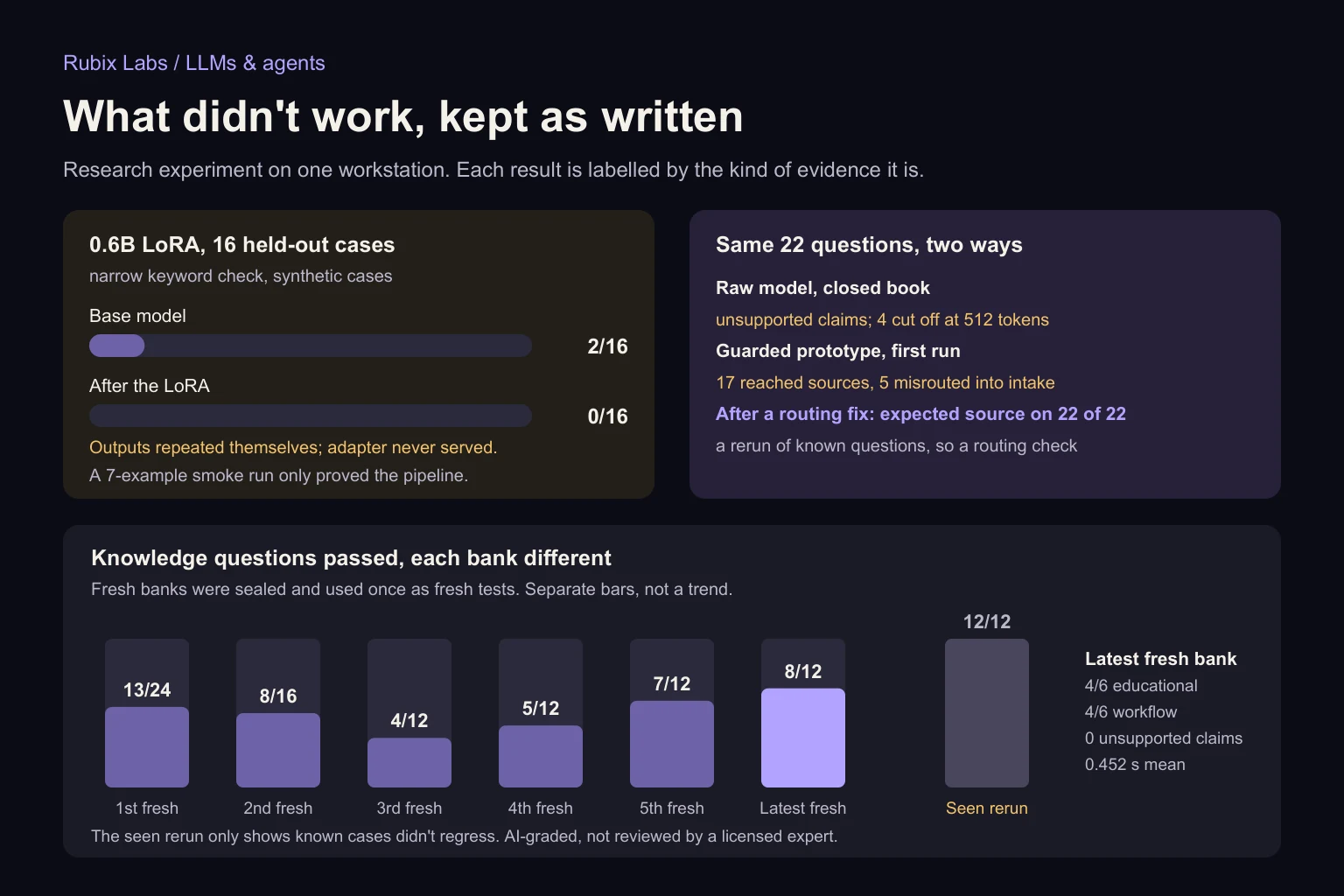
On a narrow keyword check, the base model passed 2 of the 16. The adapter passed none. Its outputs repeated themselves and reasoned wrongly about insurance. A separate 16-case check that asked for structured facts, missing fields and source ids as strict JSON got zero valid objects from the base model. We kept the adapter on disk and never served it. At this size the training plumbing worked and the model didn't.
8/12 on fresh questions, 12/12 on seen ones
For insurance knowledge, the assistant answered from a frozen revision of 240 source notes and 172 URLs, with a 4-bit Q4 build of Qwen3.5-9B selecting sources rather than writing free-form answers. We sealed a fresh 12-question bank before freezing that revision. It passed 8: 4 of 6 educational questions and 4 of 6 staff-workflow ones. The other four were safe but incomplete or misrouted, and the review found no explicit unsupported claims about coverage, price, eligibility, binding or similar outcomes. Mean latency was 0.452 seconds, and 11 of the 12 answers used the model's source selection rather than the deterministic fallback.
Against the same frozen revision we reran the previous revision's bank, already used once, and it scored 12 of 12. That's the better-looking number and the weaker evidence. It shows those known cases didn't regress, and it can't be compared with the 8 of 12 or read as general competence. An AI reviewer graded both runs against a rubric; no licensed insurance expert has reviewed them.
Five earlier fresh scores that aren't a trend
The fresh banks before that one scored 13/24, 8/16, 4/12, 5/12 and 7/12 across successive revisions. Put 8/12 at the end and it's tempting to see a dip and a recovery. Each bank was a different set of questions, some of a different size, and each was used once as a fresh test, so each score describes one revision on its own questions. Together they're a list, not a learning curve, which is why the figure draws them as separate bars.
Raw model against the guarded prototype on 22 questions
We ran 22 locked questions two ways. Closed-book, the raw Q4 model often reached a sensible conclusion and then added things no source supported, such as a usual 60-day enrollment window, or that some health insurance Marketplace plans may exclude pre-existing conditions. Four answers hit the 512-token limit and stopped mid-sentence.
The guarded prototype did much better where it reached its retrieval path, but its first run sent five questions into intake instead. Four got a request for a state and nothing else, and one turned the question's mistaken premise into a stored risk fact. We added an intent guard so questions can't create or update risk facts, leaving the model, prompts and knowledge unchanged. The rerun attached the expected source to all 22.
It's the same 22 questions, so 22 of 22 is a routing regression check, not accuracy. It isn't a fair model comparison either, because the guarded prototype can take deterministic routes the raw model can't. One answer needed the direct source fallback after an invalid model selection, and some still tacked on an irrelevant extra summary.
How the ledger labels results
The experiment's ledger sorts results into four kinds of evidence, and a number means little until you know which kind it is.
- Fair comparison: the same task under the same conditions. Its scope still limits the claim.
- Rejected comparison: a confound, such as a token cap that cut off one side's answers, so it stays as a diagnostic only.
- Seen regression: a rerun of questions already used. It catches breakage and validates nothing new.
- Interrupted or negative: the run stopped, produced nothing usable or exposed a failure, and it stays in the ledger as it happened.
Before you fine-tune anything
Score the base model on the same held-out cases before you train anything, seal a fresh test before you freeze the system, and record a zero as a zero. If a rerun of known questions is your best number, say so right next to it. Here, the base model's 2 of 16 is what made the adapter's 0 of 16 readable as a regression rather than just a low score. The safety results from the same experiment, where a local model drove a CRM under a strict controller, are in a separate post.
Rubix's LLM fine-tuning work starts the same way: evaluation against a well-prompted baseline, and we'll tell you if the baseline is already good enough. Our pricing page lists it under custom models, and our AI workflow pilot guide covers keeping an evaluation set outside the demo.